In this guide
Key takeaways
- A serious engagement covers strategy, creative, campaign configuration, deployment, optimisation and reporting.
- The guide compares consulting, implementation and fully managed models, with a realistic 30-day plan and the deliverables to expect.
- It also says plainly when ChatGPT Ads consulting is not the right fit.
Surgelify provides specialist ChatGPT Ads consulting covering strategy, creative development, campaign configuration, deployment, ongoing optimisation, and reporting. This page explains what a structured engagement involves, who it is suited to, how Surgelify delivers the work, and where consulting is not the right fit.
Platform note: ChatGPT Ads are sponsored placements that appear below ChatGPT's responses, clearly labelled as sponsored. Ads do not influence ChatGPT's answers, which run on entirely separate systems. No advertiser, at any budget level, can alter what the model says.
Who ChatGPT Ads Consulting Is For
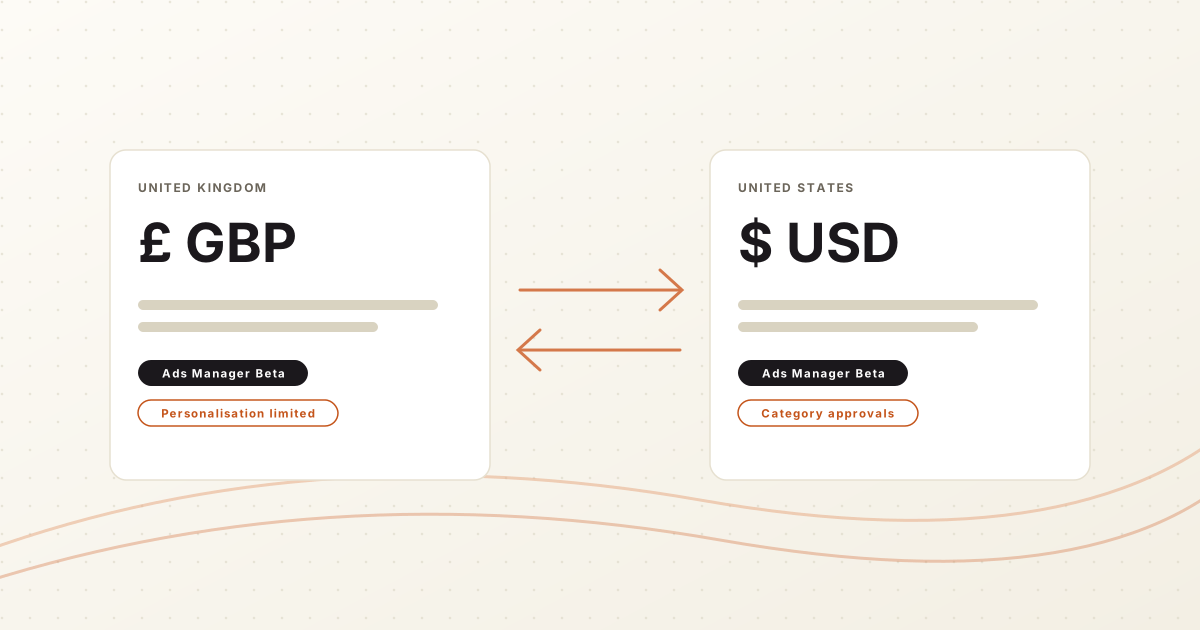
ChatGPT Ads consulting is most productive when a business has a clear commercial offer, a viable conversion destination, and enough internal capacity to act on what the campaign produces. The channel is not yet universal: OpenAI's Ads Manager availability varies by country, and ads currently reach only Free and Go plan users, not Plus, Pro, Business, Enterprise, or Edu accounts.
Within those constraints, consulting tends to deliver the most value for:
Ecommerce brands
Businesses selling physical or digital products with established product feeds are well-positioned for ChatGPT Ads. The platform supports Shopping Carousel formats, making it possible to surface products directly within relevant conversations. The key commercial question is whether the average order value and repeat purchase rate justify the cost-per-click at current bid levels.
B2B SaaS companies
Software businesses with a defined buyer persona and a high-consideration purchase journey benefit from reaching users at the research and comparison stage of the funnel. A prospect asking ChatGPT to compare project management tools or evaluate CRM options is further along in their decision process than most search queries suggest. For B2B SaaS, the consulting engagement focuses heavily on buyer-prompt research: identifying the specific conversational contexts in which your product is most relevant. See Surgelify's B2B SaaS ChatGPT Ads playbook for category-specific guidance.
Professional services
Law firms, accountancy practices, consultancies, and specialist agencies operate in categories that OpenAI is rolling out gradually with manual approval. Eligibility in regulated verticals requires demonstrating compliance with applicable professional standards. For firms that qualify, the opportunity is significant: buyers researching professional services through ChatGPT are typically engaged in high-stakes decisions where a relevant, credible placement carries genuine weight.
Enterprise teams
Larger organisations with existing paid media programmes are often evaluating ChatGPT Ads as an incremental channel rather than a primary one. The consulting model here typically involves integrating ChatGPT Ads into a broader measurement framework and assessing cannibalisation risk against existing Google and Meta spend.
Businesses with high-consideration purchase journeys
Any category where buyers spend time researching, comparing options, and asking detailed questions before committing is structurally well-suited to conversational advertising. This includes financial products (subject to eligibility), home improvement, B2B software, specialist equipment, and professional services. The longer the buying cycle, the more valuable it is to be present during the research phase.
Surgelify observation: The businesses that see the clearest early results from ChatGPT Ads are those with a specific, well-defined offer rather than a broad product catalogue. Context hints, the mechanism that determines where ads appear in conversations, require precision. Vague or overly broad targeting produces diffuse delivery and makes optimisation difficult.
Consulting, Implementation, or Fully Managed: Choosing the Right Model
Surgelify offers three distinct service models. The right one depends on your internal capability, the pace at which you want to move, and how much ongoing involvement you need.
| Service model | What it covers | Best suited to |
|---|---|---|
| Consulting | Strategy, buyer-prompt research, campaign structure design, creative direction, and reporting framework. You or your team execute. | Businesses with an in-house paid media team that needs specialist ChatGPT Ads expertise to lead the strategy |
| Implementation | Everything in consulting, plus Surgelify builds the campaign inside OpenAI Ads Manager, configures tracking, and hands over a live, tested campaign | Teams that want a properly built foundation but will manage ongoing optimisation internally |
| Fully managed | End-to-end: strategy, build, launch, daily optimisation, creative refresh, and monthly reporting. Surgelify runs the account on your behalf | Businesses without in-house paid media resource, or those that want full specialist management from day one |
Surgelify recommendation: Most businesses engaging with ChatGPT Ads for the first time benefit from the fully managed model for at least the first 60 to 90 days. The platform is evolving quickly, context hint refinement requires ongoing attention, and the measurement picture is still maturing. Handing optimisation to an internal team before a clear performance baseline exists tends to produce inconsistent results.
If you have an existing paid media team and are primarily looking for strategic input and an independent review of your approach, the consulting model is the more efficient starting point.
The Surgelify Delivery Model
Every Surgelify engagement follows a structured delivery sequence. The order matters: launching before completing eligibility checks, buyer-prompt research, and tracking configuration produces campaigns that are difficult to optimise and harder to measure.
Discovery and commercial objectives
The engagement begins with a structured discovery session covering your commercial objectives, target audience, product or service offer, existing paid media activity, and the conversion actions that matter most. Surgelify uses this to establish whether ChatGPT Ads is the right channel for your specific situation before any campaign work begins.
Confirmed platform fact: OpenAI recommends a starting maximum CPC bid of $3 to $5 USD per click for Clicks campaigns. The auction is relevance-weighted, meaning the highest bid does not automatically win. Relevance between the ad, the landing page, and the conversational context is a primary factor in placement decisions.
Product, audience, and buyer-prompt research
This is the most distinctive element of ChatGPT Ads strategy. Unlike keyword-based search advertising, ChatGPT Ads use context hints at the ad group level: natural-language descriptions of the conversations, topics, and situations in which your product or service is relevant. These hints guide ad matching but are not exact-match keywords and do not guarantee delivery in specific conversations.
Surgelify maps the buyer journey through ChatGPT: the questions your audience is likely asking, the comparison prompts they use, the decision-stage language they employ. This research informs both the context hint architecture and the creative approach.
Eligibility and policy checks
Before campaign build begins, Surgelify verifies:
-
Advertiser eligibility for your country via OpenAI's Ads Manager availability
-
Product or service category compliance against OpenAI's ad content policies
-
Landing page alignment with platform standards
-
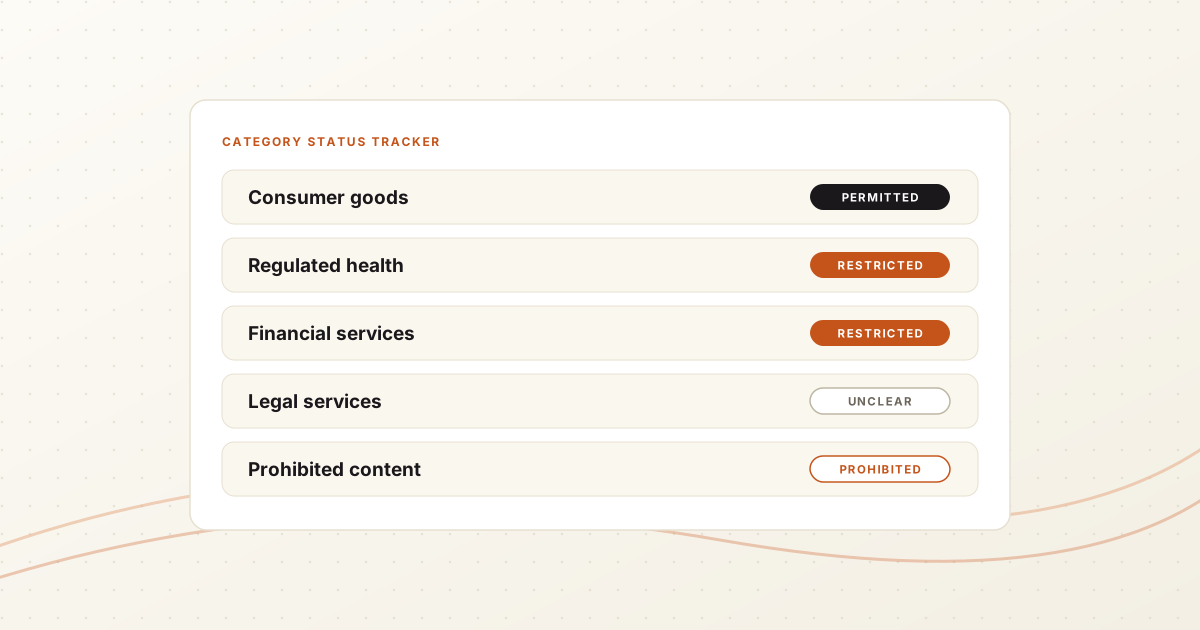
Any category-specific approval requirements (regulated verticals including financial services, healthcare, and legal services require manual review by OpenAI)
Confirmed platform fact: During the initial rollout period, ads are primarily available in consumer verticals including lifestyle and household goods, local services, travel and experiences, and digital products or education. Financial services, healthcare, and legal services are being approved on a case-by-case basis. All other categories are currently disallowed. Source: OpenAI Ad Policies
Creative and offer development
ChatGPT Ads appear below the model's response, clearly labelled as sponsored, under tight character constraints. The creative environment is different from search or social: the ad must read as a natural continuation of a conversation rather than an interruption. Surgelify develops ad copy, headline variants, and landing page recommendations aligned with the conversational context the campaign is targeting.
Campaign set-up and launch QA
Surgelify builds the campaign inside OpenAI Ads Manager under your account ownership. Permissioned access means you retain full control and ownership of the account and its conversion history. The build covers campaign objective selection, ad group architecture, context hint development, creative upload, conversion tracking via the OpenAI Pixel and Conversions API, and UTM structure. A pre-launch QA check validates tracking accuracy before spend begins.
Optimisation and reporting
Once live, the account is monitored daily. Optimisation covers context hint refinement, bid management, creative testing, budget pacing, and landing page performance. Monthly reporting covers delivery metrics, engagement, conversion data, and commercial outcomes, with clear separation between what is measured directly and what is inferred.
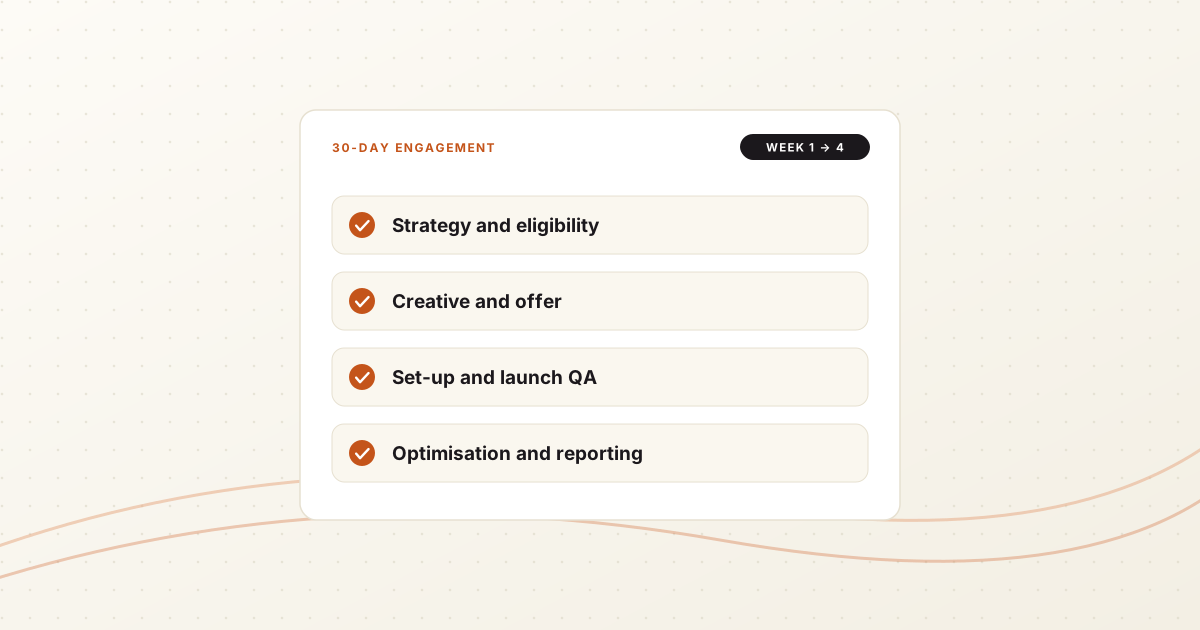
A Realistic 30-Day Engagement Plan
The timeline below reflects a standard first engagement. Timings can compress or extend depending on the complexity of the category, the speed of eligibility approval for regulated verticals, and the client's internal review cycles.
For a full pre-launch checklist, see the Surgelify ChatGPT Ads campaign launch guide.
Week 1: Discovery, research, and eligibility
-
Kick-off session: commercial objectives, audience definition, offer clarity, and conversion actions
-
Buyer-prompt research: mapping the conversational contexts relevant to your product or service
-
Eligibility verification: country availability, category compliance, and any regulated-vertical approval requirements
-
Baseline AI visibility audit: understanding where your brand currently appears in organic ChatGPT responses, separate from paid activity
Week 2: Strategy and creative
-
Strategy document: campaign objectives, audience approach, context hint architecture, funnel stage targeting, and bid strategy
-
Creative development: ad copy variants, headline options, and landing page recommendations
-
Offer review: assessing whether the commercial offer is strong enough to convert from a conversational placement
-
Client review and sign-off on strategy and creative direction
Week 3: Configuration, tracking, and QA
-
Account set-up inside OpenAI Ads Manager under client ownership
-
Campaign and ad group build: context hints, creative upload, objective selection
-
Conversion tracking implementation: OpenAI Pixel, Conversions API, UTM structure, GA4 event validation
-
Pre-launch QA: tracking verification, policy compliance review, landing page alignment check
Week 4: Launch and first optimisation cycle
-
Campaign goes live
-
Delivery monitoring: spend pacing, impression volume, click-through behaviour
-
Initial context hint performance review: identifying which ad groups are matching relevant conversations
-
First optimisation adjustments: bid refinement, creative rotation, early signal review
-
Week 4 summary report: delivery data, early observations, and recommended next steps
Surgelify observation: The first four weeks produce directional data rather than definitive conclusions. ChatGPT Ads is a newer channel with a smaller addressable audience than established platforms, and the measurement infrastructure is still developing. Meaningful optimisation decisions typically require six to eight weeks of delivery data.
Deliverables Clients Should Expect
A structured ChatGPT Ads engagement should produce a defined set of documented outputs. These are the artefacts Surgelify produces as part of a standard engagement:
| Deliverable | Description |
|---|---|
| Strategy document | Campaign objectives, audience definition, funnel approach, context hint architecture, bid strategy, and success criteria |
| Buyer-prompt research | A mapped set of conversational contexts, question types, and decision-stage prompts relevant to your product or service |
| Campaign structure | Ad group architecture, context hint sets, objective selection, and creative placement plan built inside OpenAI Ads Manager |
| Creative recommendations | Ad copy variants, headline options, and landing page guidance aligned to conversational context and platform format requirements |
| Tracking plan | OpenAI Pixel configuration, Conversions API setup, UTM structure, GA4 event mapping, and a reconciliation note explaining where OpenAI Ads Manager and GA4 figures may diverge |
| Reporting framework | A structured reporting template separating delivery metrics (impressions, clicks, spend), engagement signals, conversion data, and commercial outcomes |
Surgelify recommendation: Treat the buyer-prompt research document as a reusable asset beyond the campaign itself. The conversational patterns it identifies are relevant to content strategy, organic AI visibility work, and broader messaging development. For guidance on how paid and organic ChatGPT presence interact, see the Surgelify ChatGPT Ads UK guide.
When ChatGPT Ads Consulting Is Not the Right Fit
Not every business is in a position to use ChatGPT Ads productively. Surgelify will say so directly during the discovery process if any of the following apply.
Restricted category. If your product or service falls outside the categories OpenAI currently permits, the campaign cannot run. This includes gambling, political advertising, certain health claims, and other restricted verticals. Some regulated categories may become eligible over time as OpenAI expands its approval process.
Weak offer or unclear product-market fit. ChatGPT Ads reach users who are actively researching and comparing options. A placement that reaches the right conversation but fails to communicate a clear, credible value proposition will not convert. If the offer itself needs work, that is the higher-priority problem.
No viable conversion destination. The landing page is a primary factor in OpenAI's ad relevance assessment. A weak, misaligned, or slow-loading landing page will reduce delivery quality and conversion rate simultaneously. Consulting cannot compensate for a destination that does not work.
No capacity to act on leads. For businesses where the campaign objective is lead generation, there needs to be a process in place to follow up promptly. A campaign that generates enquiries that go unanswered produces cost without commercial return.
Need for immediate guaranteed revenue. ChatGPT Ads is a relatively new channel with a developing measurement infrastructure. It is not suited to businesses that need guaranteed, immediate returns or that cannot absorb the learning period that any new paid channel requires. Surgelify does not guarantee outcomes, and any consultancy that does is overstating what can be controlled.
How Surgelify Measures Progress
Surgelify separates campaign measurement into four distinct layers. Conflating them produces misleading conclusions about what is and is not working.
Delivery outcomes
What the platform actually served: impressions, spend, reach, and frequency. These confirm the campaign is running and reaching the intended audience. They do not indicate whether the campaign is producing commercial value.
Engagement outcomes
How users responded to the ad: click-through rate, clicks, and landing page arrival. Engagement data indicates whether the creative and context hint combination is generating interest from the right conversations. High impression volume with low engagement typically signals a context hint or creative problem.
Conversion outcomes
Actions taken on the destination: form submissions, purchases, sign-ups, or other defined conversion events tracked via the OpenAI Pixel and Conversions API. Surgelify's tracking plan includes a reconciliation note explaining where OpenAI Ads Manager and GA4 may report different figures, and why. Both sources are reported; neither is treated as the definitive single source of truth without qualification.
Commercial outcomes
The business-level impact: cost per acquisition, revenue influenced, pipeline generated, or customer lifetime value contribution. This layer requires a longer measurement window and, in most cases, integration with CRM or revenue data. Surgelify frames commercial outcomes as directional assessments rather than precise attribution claims where the data does not support precision.
Surgelify recommendation: For a detailed explanation of the measurement framework, reporting cadence, and the specific metrics Surgelify tracks across each layer, see the Surgelify ChatGPT Ads results and measurement guide. That guide also covers the limitations of current third-party measurement tools and how to interpret assisted-conversion data.
For an independent view of how Surgelify's ChatGPT Ads service compares to other providers, see the ChatGPT Ads agency rankings.
What a ChatGPT Ads Consultancy Should Include
Use this table to evaluate any ChatGPT Ads consulting engagement, including Surgelify's. A credible consultancy should be able to account for each element before campaign spend begins.
| Element | What to look for | Red flags |
|---|---|---|
| Eligibility verification | Confirms your category and country are eligible before recommending spend | Proceeds to campaign build without checking policy compliance |
| Buyer-prompt research | Maps the specific conversations your audience is having in ChatGPT, not generic keyword lists | Relies on keyword research from Google Ads without adapting for conversational context |
| Context hint architecture | Builds ad group structure around natural-language conversation descriptions | Uses single broad context hints across all ad groups |
| Creative development | Ad copy written for conversational placement, not repurposed from search or social | Reuses existing Google Ads copy without adaptation |
| Conversion tracking | Implements OpenAI Pixel and Conversions API with GA4 validation | Launches without conversion tracking in place |
| Measurement framework | Separates delivery, engagement, conversion, and commercial outcomes | Reports only impressions and clicks as evidence of performance |
| Account ownership | Client owns the OpenAI Ads Manager account; consultancy operates via permissioned access | Agency retains account ownership or cannot transfer it |
| Honest scope | Clearly states what the channel can and cannot do at current scale | Claims guaranteed results or positions ChatGPT Ads as a replacement for established channels |
| Policy literacy | Can explain current category restrictions, audience eligibility, and brand safety controls | Cannot answer basic questions about who sees the ads or what categories are restricted |
30-Day Launch Checklist
Save or download this checklist to track your ChatGPT Ads launch readiness.
Week 1: Discovery and eligibility
-
Commercial objectives defined and agreed
-
Target audience and conversion actions documented
-
Country eligibility confirmed via OpenAI Ads Manager availability
-
Product or service category checked against OpenAI ad content policies
-
Regulated-vertical approval process initiated if applicable
-
Baseline AI visibility audit completed
Week 2: Strategy and creative
-
Buyer-prompt research completed
-
Context hint architecture drafted
-
Campaign objectives and funnel stage targeting agreed
-
Ad copy variants written and reviewed
-
Landing page assessed and recommendations documented
-
Strategy document signed off by client
Week 3: Configuration and QA
-
OpenAI Ads Manager account created under client ownership
-
Campaign and ad group structure built
-
Context hints uploaded and reviewed
-
OpenAI Pixel implemented
-
Conversions API configured
-
UTM structure applied
-
GA4 events validated
-
Pre-launch QA completed: tracking, policy, landing page
Week 4: Launch and first cycle
-
Campaign live
-
Spend pacing confirmed
-
Delivery data reviewed: impressions, clicks, CTR
-
Initial context hint performance assessed
-
First bid and creative adjustments made
-
Week 4 summary report delivered
Discuss a ChatGPT Ads Engagement
If you are evaluating ChatGPT Ads for your business and want to understand whether it is the right fit before committing to spend, Surgelify's starting point is always a structured discovery conversation.
That conversation covers your commercial objectives, offer, audience, existing paid media activity, and the conversion actions that matter. It also covers eligibility: if your category or country is not yet supported, we will say so rather than recommend a campaign that cannot run.
To start that conversation, get in touch with the Surgelify team.
For further reading:
Published: October 2026 | Last updated: October 2026 | Last verified: October 2026 This page covers time-sensitive platform information. Content is reviewed monthly.