In this guide
Key takeaways
- ChatGPT Ads launched in the US on 9 February 2026 and went live in the UK on 6 June 2026, with self-serve access through OpenAI Ads Manager.
- There are no keywords and no demographic audiences, so Google or Meta habits will not carry over.
- The guide covers objectives, context hints, budgeting, creative, landing pages and a three-layer tracking stack.
- It closes with what is different between the UK and US.
ChatGPT advertising is no longer a pilot programme for holding company clients with six-figure commitments. Since OpenAI opened its self-serve Ads Manager to all advertisers in May 2026, any business can launch a campaign with a daily budget starting at £15 in the UK or $25 in the US. The minimum daily spend that once sat at $200,000 during the closed pilot has been removed entirely.
That accessibility creates a genuine first-mover opportunity, but it also creates a trap. Marketers who approach ChatGPT Ads with the same mental model they use for Google Search or Meta will struggle. There are no keywords. There are no demographic audiences. The targeting logic, the creative format, and the measurement approach all work differently.
This guide covers everything a marketing leader or growth team needs to launch a well-structured ChatGPT campaign, from account setup through to measurement, with specific guidance on the differences between the UK and US markets.
Key fact: ChatGPT Ads launched in the US on 9 February 2026 and went live in the UK on 6 June 2026, making Britain OpenAI's first European advertising market. Self-serve access is now available in both markets through OpenAI Ads Manager.
What ChatGPT Ads Actually Are
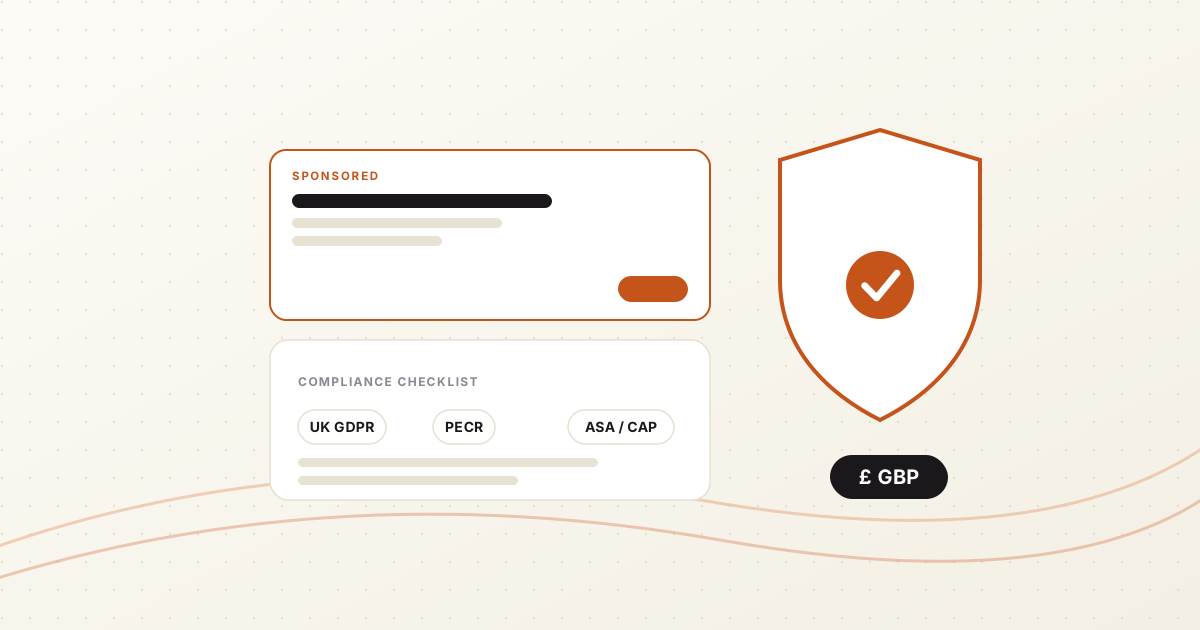
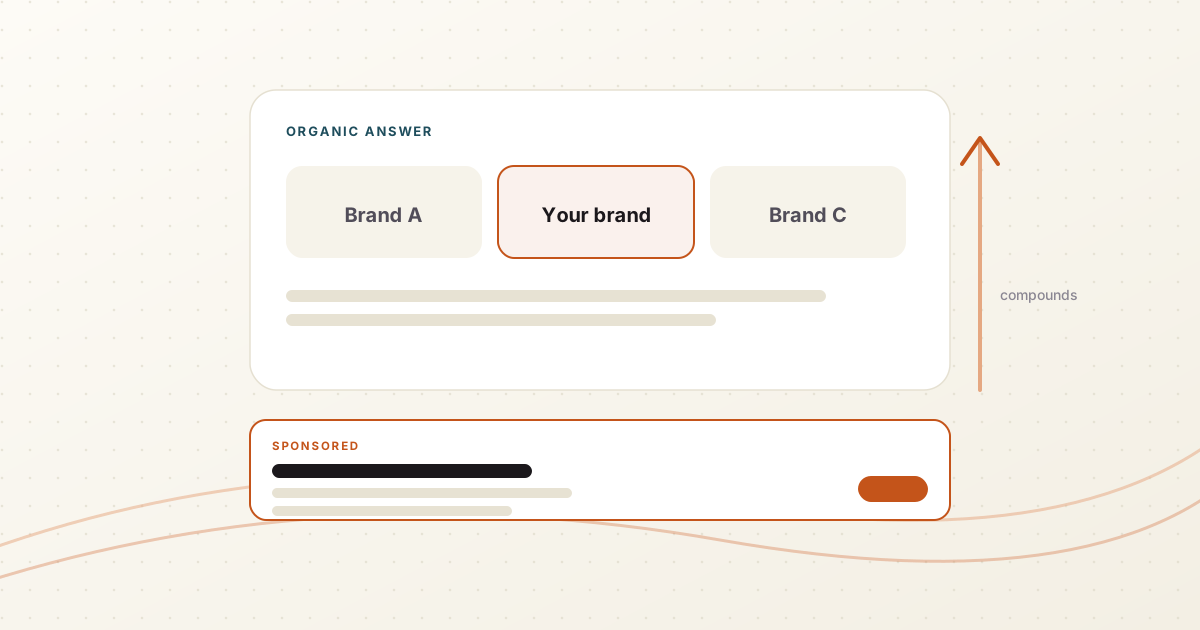
ChatGPT Ads are sponsored placements that appear at the bottom of a ChatGPT conversation, clearly labelled as "Sponsored" and visually separated from the AI's organic response. They do not appear inside the answer itself, and OpenAI has been explicit that advertising has no influence on what ChatGPT says.
The format is deliberately minimal. Each ad consists of:
-
An advertiser name and favicon
-
A headline (up to 50 characters)
-
A description (up to 100 characters)
-
A destination URL
-
An optional image (PNG or JPG, square, minimum 256 x 256 px)
A second format, the product feed card, allows ecommerce brands to surface product data including price and star ratings directly within the placement. This is particularly relevant for retailers and DTC brands.
Ads reach only users on ChatGPT's Free and Go subscription tiers. Anyone on Plus, Pro, Business, Enterprise, or Education plans sees no advertising. OpenAI also excludes users it identifies as being under 18.
What this means commercially: the addressable audience skews toward people who are actively researching, comparing options, and exploring decisions, but have not yet committed to a paid professional tool. For considered-purchase categories in B2B and ecommerce, that is precisely the moment worth reaching.
Campaign Objectives: Choosing the Right Buying Model
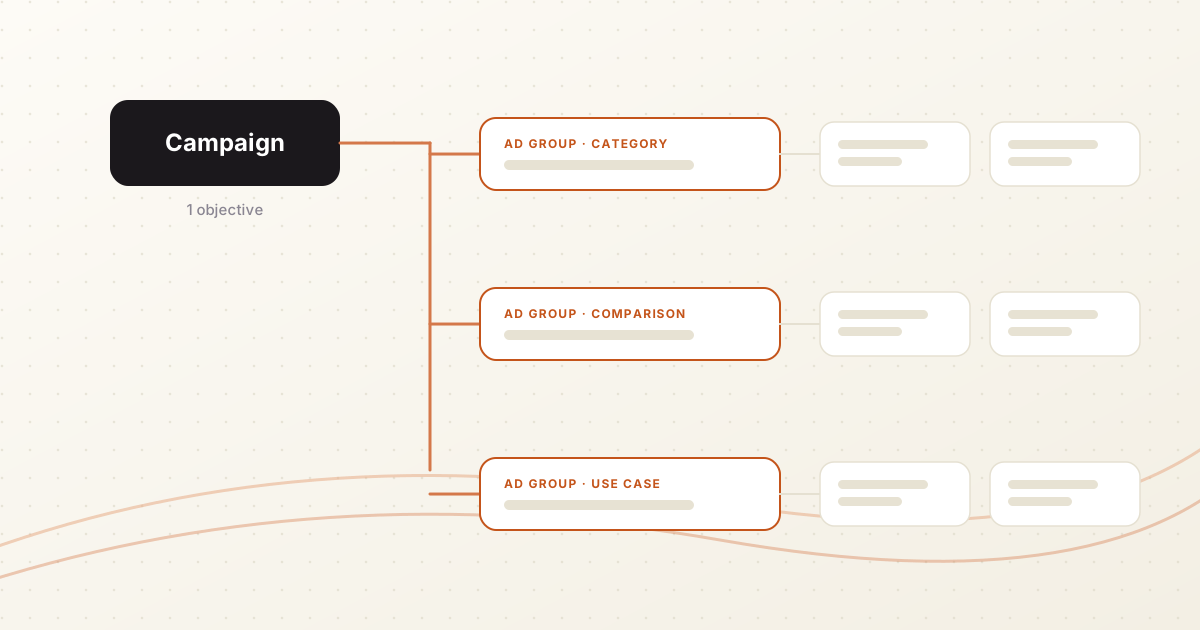
The campaign structure in OpenAI Ads Manager follows a familiar hierarchy: Campaign, then Ad Group, then Ad. The objective you select at campaign level determines how the auction prices your delivery and what optimisation signal the system uses.
Three objectives are currently available:
| Objective | Buying model | Best for |
|---|---|---|
| Reach | CPM (cost per thousand impressions) | Brand awareness, new market entry, product launches |
| Clicks | CPC (cost per click) | Traffic generation when conversion data is limited |
| Conversions (oCPC) | Billed per click, optimised toward conversion | Bottom-funnel campaigns with a tracked conversion event |
Which objective to start with
Most first-time advertisers should begin with Clicks. The platform needs data before it can optimise toward conversions, and the Conversions objective requires a standard conversion event that fires with enough frequency to guide delivery. Starting with Clicks builds that data foundation while generating measurable traffic.
Once a conversion event has meaningful volume, switching to Conversions (oCPC) is the stronger choice for decision-stage campaigns. Note that the campaign objective cannot be changed after creation, so this requires a new campaign.
For B2B brands, early-stage campaigns targeting broad research conversations suit Reach. Consideration-stage campaigns targeting evaluation queries suit Clicks. Decision-stage campaigns with a defined conversion event suit oCPC.
Important: Organise campaigns around decision stage, not product line. A single product can appear in awareness, consideration, and decision campaigns simultaneously, each with different context hints and landing pages.
Audience and Intent Signals: Context Hints Explained
This is where ChatGPT Ads departs most significantly from every other paid media platform. There are no keywords to bid on. There are no demographic targeting options. There are no in-market audience segments.
The primary targeting mechanism is called context hints, set at the ad group level. Context hints are freeform descriptions of the conversations in which your product or service is relevant. OpenAI uses these hints to match your ad to conversations that share that context, but they are not exact-match targeting rules.
Writing context hints that actually work
Weak context hints describe a product. Strong context hints describe a buyer in a moment of need.
Weak: "Project management software for teams"
Strong: "A team leader trying to reduce missed deadlines and handover confusion without adding another tool to the stack"
A practical formula from OpenAI's own guidance: [Audience] + [task or problem] + [situation or constraint] + [relevant product capability]. Write it in the user's voice, not the marketer's.
Additional targeting levers available at campaign level:
-
Geography: Country-level targeting everywhere; US advertisers can also target by state, DMA, or ZIP code. UK advertisers currently target at country level only.
-
Platform: Target by iOS app, Android app, desktop web, iOS web, or Android web.
-
Custom audiences: Upload first-party data (customer emails and phone numbers) to target or exclude matched users. The minimum threshold is 25,000 matched users, which limits this feature for most smaller advertisers.
The practical implication for ecommerce: product feed ads can reach users mid-conversation when they are actively researching a purchase category. A well-written context hint for a homeware brand might describe someone asking ChatGPT for help furnishing a first flat on a specific budget, rather than simply naming the product category.
Budgeting: What to Spend and How the Auction Works
The auction on ChatGPT Ads is relevance-weighted, which means your bid is only one input into placement decisions. Ad relevance to the user's conversation and landing page quality also factor into ranking. A lower bid with a highly relevant ad and a well-matched landing page can outperform a higher bid with generic creative.
Minimum budgets
| Currency | Minimum daily budget |
|---|---|
| GBP | £15 |
| USD | $25 |
| EUR | €15 |
| AUD | $25 AUD |
Recommended starting bids
-
CPC campaigns: $3 to $5 per click is the recommended starting range. B2B campaigns targeting high-value audiences may see CPCs of $8 to $15 due to the depth of the audience signal.
-
CPM campaigns: OpenAI's initial default max bid was $60 CPM; real-world rates have reportedly fallen as the auction matured.
-
oCPC campaigns: Set a bid cap per ad group representing the maximum you are willing to pay per conversion.
How the daily budget works
The daily budget is an average over a seven-day rolling period, not a hard daily cap. Spend can reach up to twice the selected daily amount on any individual day, provided the seven-day total does not exceed seven times the daily budget. If you change the daily budget mid-week, the cap is prorated from the change date through the following Sunday midnight.
The practical consequence: do not set a daily budget and assume spend will be capped at exactly that figure each day. Build reconciliation into your weekly reporting cycle and monitor for days where spend spikes above the daily target.
For a first campaign, a controlled test budget of £500 to £1,500 over four weeks is a reasonable starting point to gather meaningful performance data before scaling.
Creative Formats and Messaging
The current self-serve format is the chat card: a headline, a brief description, an optional image, and a destination URL. The constraints are tight, and that is the point. Every character has to earn its place.
What makes a strong ChatGPT ad
The user has just had a conversation with an AI. They are in a research or decision mindset. An ad that interrupts with a generic brand claim will be ignored. An ad that continues the conversation, acknowledging the problem the user was just exploring, will perform.
Three creative principles that hold up across categories:
-
Lead with the outcome, not the product. "Cut your project reporting time in half" outperforms "Project management software for teams."
-
Match the conversation stage. An ad appearing in a research-phase conversation should offer information (a guide, a benchmark, a comparison). An ad in a decision-phase conversation should offer action (a demo, a consultation, a trial).
-
Test meaningfully different reasons to click. OpenAI recommends multiple distinct ads per ad group. Distinct means different value propositions, not the same claim with synonyms. Test a specific outcome, a proof point, a competitive differentiator, and a risk-removal offer as separate ads.
Product feed ads for ecommerce
Ecommerce brands can submit a product feed to serve ads using live product data, including price and star ratings displayed directly in the placement. This format is particularly effective for high-consideration product categories where price and social proof are active decision factors.
Creative spec summary: Headline up to 50 characters (may be truncated). Description up to 100 characters (may be truncated). Image: PNG or JPG, square format, minimum 256 x 256 px. No video or carousel formats are currently available in self-serve.
Landing Page Requirements
The landing page is not a secondary concern on ChatGPT Ads. It is part of the relevance signal that determines how your ad ranks in the auction. A mismatch between the ad's promise and the landing page's content will hurt both conversion rates and delivery efficiency.
The three-part alignment rule
Every campaign should follow one uninterrupted path: user need, stated in the context hint → ad promise, stated in the headline and description → landing page proof, confirming the promise → next action, matched to the user's decision stage.
Sending every campaign to the homepage breaks this chain. Each ad group should point to the most specific, relevant destination available.
Pre-launch landing page checklist
Before activating any campaign, verify the following:
-
The page immediately confirms the ad's promise in the headline or above the fold
-
The CTA matches the user's likely stage of awareness (information offer for research stage; demo or purchase for decision stage)
-
The page performs well on mobile and web (ads serve across iOS, Android, and desktop)
-
UTM parameters survive any redirects on the destination URL
-
The conversion event (form submission, purchase, sign-up) fires correctly and is tracked
-
The page does not block OAI-AdsBot or OAI-SearchBot in robots.txt
-
The creative and destination comply with the same ad policy category
The last point matters more than most advertisers realise. OpenAI reviews both the ad and the landing page against its content policies. A compliant ad pointing to a non-compliant landing page will fail review.
Measurement: Setting Up a Three-Layer Tracking Stack
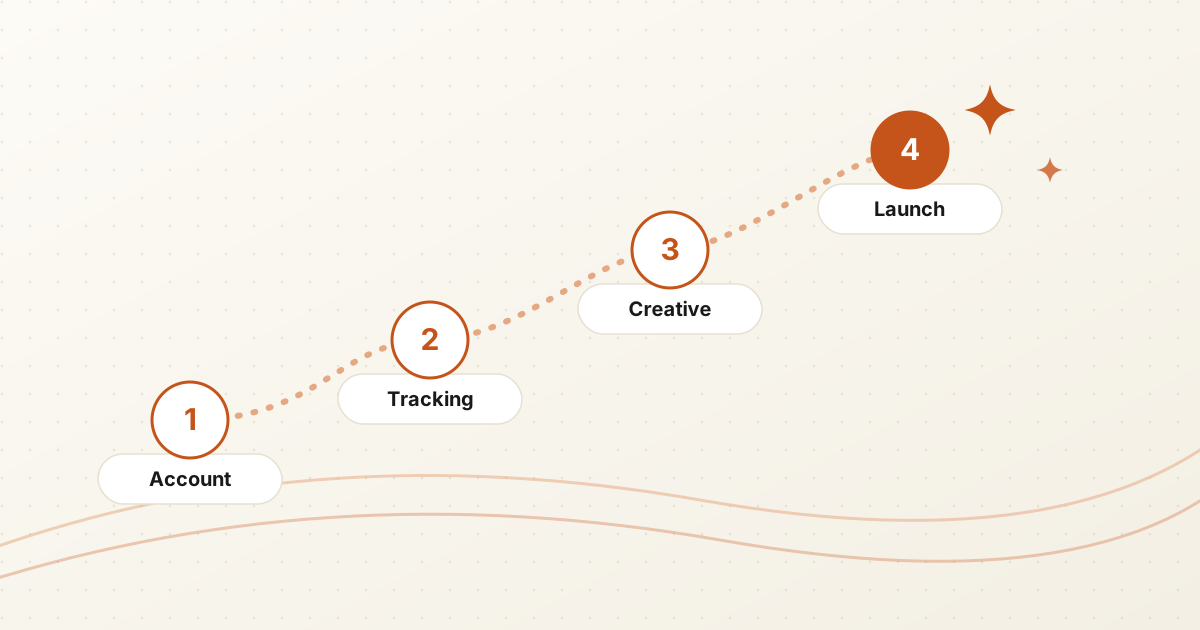
Measurement on ChatGPT Ads is still maturing, but the infrastructure available is sufficient for a rigorous first campaign if it is set up before launch, not after.
Three-layer tracking stack
OpenAI conversion measurement
Measurement Pixel or the server-side Conversions API, with consistent event IDs.
Independent analytics
UTM parameters on every destination URL so traffic shows in GA4.
CRM or revenue tracking
Source, campaign, ad group and creative stored with each lead or customer.
The three-layer measurement setup
Layer 1: OpenAI conversion measurement. Install the OpenAI Measurement Pixel on your website, or implement the server-side Conversions API. OpenAI describes the Conversions API as the more reliable source. If you run both, use consistent event IDs so the platform can deduplicate signals. Verify that your chosen standard event is active and firing before the campaign goes live.
Layer 2: Independent analytics. Add UTM parameters to every destination URL so ChatGPT Ads traffic is visible in GA4 or your analytics platform. A consistent UTM convention might look like: utm_source=chatgpt&utm_medium=paid&utm_campaign=[campaign-name]&utm_content=[ad-name]. Do not rely solely on OpenAI's reporting.
Layer 3: CRM or revenue tracking. Store the source, campaign, ad group, and creative identifiers with each lead or customer record. This is the layer that connects ad spend to downstream revenue and allows you to evaluate lead quality, not just lead volume.
What OpenAI's Ads Manager reports
The platform currently reports impressions, clicks, spend, CTR, average CPC, and average CPM, broken down by day and by campaign, ad group, and ad level. Conversion reporting is available when the pixel or Conversions API is installed.
What it does not report: audience demographics, device-level breakdowns beyond platform targeting, or any data about the conversations in which your ads appeared. The platform keeps conversation content private from advertisers by design.
Evaluate ChatGPT Ads performance on cost per qualified lead and pipeline value, not click-through rate alone. CTR on a new platform with a novel ad format is not a reliable indicator of commercial quality.
UK vs US: What Is Different and What It Means for Your Campaign
The US and UK markets are both open for self-serve advertising, but they are not identical. Understanding the differences prevents wasted budget and unrealistic expectations.
| Factor | United States | United Kingdom |
|---|---|---|
| Consumer ads live since | 9 February 2026 | 6 June 2026 |
| Self-serve Ads Manager | Available since May 2026 | Available since 19 June 2026 |
| Geo targeting granularity | Country, state, DMA, ZIP code | Country level only |
| Minimum daily budget | $25 USD | £15 GBP |
| Consent requirements | Standard US digital advertising rules | OpenAI's EU/UK ads policy (updated 2 June 2026) requires explicit user consent for personalised ads |
| Auction maturity | More established; CPMs have fallen from ~$60 at launch | Earlier stage; pricing benchmarks still developing |
| First UK advertisers | N/A | Tesco, Hilton, Hiscox, Next (via Dentsu) |
Practical implications for UK advertisers
The UK market is earlier in its development than the US, which has two consequences. First, competition in the auction is lower, which may produce more efficient CPCs and CPMs during this window. Second, the platform's optimisation signals are less mature, so campaigns require more manual oversight and longer learning periods.
UK advertisers cannot yet target below country level. This is a meaningful limitation for brands with strong regional concentration or those running location-specific promotions. US advertisers running parallel campaigns benefit from the ability to isolate performance by state or DMA.
Consent and data compliance
OpenAI's UK and EU ads policy, updated on 2 June 2026, requires explicit user consent before personalising ads. UK advertisers should ensure their campaigns are structured to comply with this requirement and that their legal teams have reviewed the policy before launch.
The strategic read: UK brands that enter the platform now, while competition is lower and the auction is less contested, are building performance data and audience learning that will compound as the market grows. Waiting for the platform to mature means competing against advertisers who already have months of optimisation history.
Ready to Launch? Work with a Specialist
ChatGPT Ads is a platform that rewards structured thinking over tactical execution. The brands that will perform well are those that approach it with a clear decision-stage framework, well-written context hints, aligned landing pages, and a measurement stack that connects spend to revenue.
Getting those fundamentals right from the start is considerably faster with specialist support. Surgelify works with ecommerce and B2B brands to plan, launch, and optimise ChatGPT advertising campaigns in both the UK and US markets, alongside organic AI visibility programmes that compound the effect of paid activity.
Book a strategy consultation with Surgelify to discuss your first ChatGPT campaign, review your current paid media setup for AI readiness, and build a launch plan that reflects the realities of the platform as it stands today.