In this guide
Key takeaways
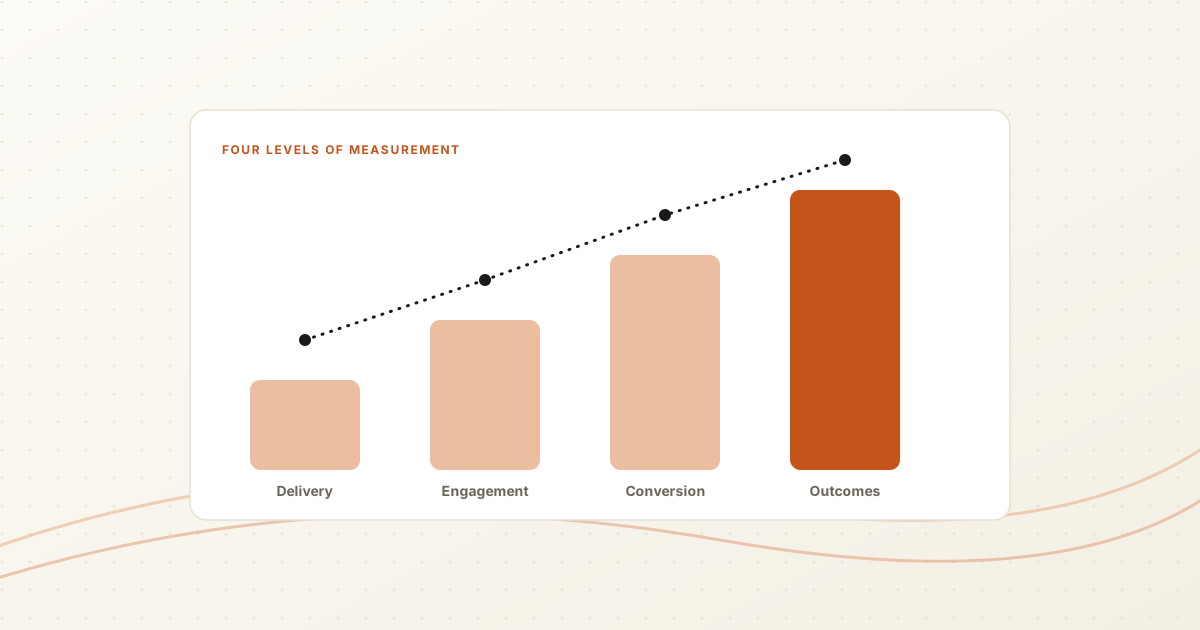
- Judge performance across four levels: delivery, engagement, conversion and commercial outcomes.
- Ads Manager Beta does not yet provide audience-level, cross-session or cross-advertiser reporting, so Google and Meta benchmarks will mislead.
- Reporting lag makes early judgements unreliable. Connect platform data to CRM and pipeline outcomes to judge business value.
ChatGPT Ads performance should be assessed across four levels: delivery, engagement, conversion, and commercial outcomes. However, measurement must reflect what the platform currently makes available. Ads Manager Beta provides a defined set of metrics; several reporting capabilities that advertisers expect from mature platforms are not yet present. This guide explains exactly what you can and cannot measure today, how to structure your review process, and how to evaluate claims made by agencies or internal teams.
Surgelify recommendation: Treat ChatGPT Ads as a channel that requires its own measurement framework. Applying standard PPC benchmarks or attribution assumptions from Google or Meta will produce misleading conclusions at this stage of the platform's development.
The Four Levels of Measurement
Measuring a ChatGPT Ads campaign means working across four distinct levels. Each level answers a different question. Conflating them is one of the most common reporting errors on this platform.
Level 1: Delivery
Delivery metrics confirm that your ads are reaching users. They do not indicate whether those users found the ad relevant or took any action.
Confirmed platform metrics (source: OpenAI Help Centre):
| Metric | What it measures |
|---|---|
| Impressions | Number of times ads were shown |
| Spend | Total amount spent in the account currency |
| Average CPM | Spend per 1,000 impressions (finalized activity) |
Data freshness note: Impressions and clicks typically refresh approximately every 15 minutes. Spend insights are delayed by approximately 7 to 8 hours, meaning a displayed spend of zero does not confirm that no charges have accrued.
Level 2: Engagement
Engagement metrics indicate whether users responded to the ad by clicking through to the landing page.
Confirmed platform metrics (source: OpenAI Ads Reporting documentation):
| Metric | What it measures |
|---|---|
| Clicks | Number of ad clicks recorded |
| Click-through rate (CTR) | Clicks divided by impressions |
| Average CPC | Average spend per click, using finalized activity |
Surgelify observation: CTR on ChatGPT Ads reflects a conversational environment. Users are in an active research or decision-making session, which means a click often carries more intent than a click from a conventional search results page. However, no cross-platform benchmark data is currently published by OpenAI to confirm this at scale.
Level 3: Conversion
Conversion metrics connect ad interactions to actions taken on your website or platform. These are only available if conversion measurement has been configured in Ads Manager Beta.
Confirmed platform metrics (source: OpenAI Help Centre):
| Metric | What it measures |
|---|---|
| Conversions | Goal conversions from clicks and eligible view-throughs within selected attribution windows |
| Cost per action (CPA) | Spend divided by conversions |
| Post-click conversion rate | Click-through goal conversions divided by clicks |
| Attributed sales | Value of attributed order_created events, in account currency |
| Return on ad spend (ROAS) | Attributed purchase value divided by spend |
Important platform limitation: Order Created Sales and Order Created ROAS are calculated only from attributed order_created events. Other standard or custom conversion events do not contribute to these columns.
Attribution windows available: Advertisers can select a 7-, 14-, or 30-day click-through reporting window and either a 0-day (disabled) or 1-day view-through reporting window.
Level 4: Commercial Outcomes
Commercial outcomes are the business results that matter beyond the campaign dashboard: qualified pipeline, customer acquisition, revenue, and competitive position. These are not reported inside Ads Manager Beta. They require integration with your CRM, analytics platform, and commercial reporting.
Surgelify recommendation: Do not judge a ChatGPT Ads campaign solely by what appears in Ads Manager. Build a parallel commercial layer that connects attributed clicks to downstream business outcomes using UTM parameters, CRM tracking, and regular sales-pipeline reviews.
What Advertisers Can Measure Today
The following capabilities are confirmed in current OpenAI documentation. All claims in this section are sourced directly from the OpenAI Help Centre and Ads reporting developer documentation.
In Ads Manager Beta, advertisers can currently:
-
View impressions, clicks, spend, CTR, average CPC, and average CPM at campaign, ad group, and ad levels
-
Set up conversion measurement using the browser Pixel or the Conversions API (server-side)
-
Track attributed conversions with configurable click-through windows (7, 14, or 30 days) and an optional 1-day view-through window
-
Add UTM parameters to landing page URLs to track ChatGPT Ads traffic in existing analytics tools such as Google Analytics 4
-
Export reporting data as CSV (cumulative or daily)
-
View performance in chart format across impressions, clicks, and spend over a selected date range
-
Break down results by time, device, and country via the ChatGPT Ads Manager plugin
-
Use the Insights API to retrieve delivery and conversion metrics programmatically at account, campaign, ad group, or ad level
For product-feed campaigns specifically, advertisers can also measure carousel product card impressions and carousel product card clicks, allowing comparison of individual product performance within a single ad unit.
Confirmed platform fact: As stated in OpenAI's FAQ, ChatGPT Ads does not yet have performance benchmarks across advertisers, industries, or campaign types. There is no published data on what a "good" CTR or CPA looks like on this platform.
This absence of benchmarks is not a flaw in the platform. It is a natural consequence of an early-stage advertising product. The implication for advertisers is that performance must be evaluated relative to your own commercial targets and, where possible, compared against your own baseline rather than against industry norms that do not yet exist.
What Cannot Yet Be Reliably Measured
Acknowledging the limits of current measurement is not a reason to avoid the channel. It is a reason to build reporting practices that do not overstate what the data shows.
No cross-advertiser benchmarks
OpenAI has confirmed that no performance benchmarks exist across advertisers, industries, or campaign types. Any agency or tool claiming to compare your ChatGPT Ads CTR against an "industry average" is presenting data that does not yet exist in any published form.
No view-through attribution beyond one day
The platform currently supports a maximum one-day view-through attribution window. For advertisers in categories with longer consideration cycles, such as B2B software, financial services, or high-value consumer purchases, this window may not capture the full influence of an ad impression on a later conversion.
No audience-segment reporting
Ads Manager Beta does not currently provide demographic or interest-based breakdowns of who saw or clicked your ads. Targeting parameters can be set, but granular audience-level performance data is not yet available in the reporting interface.
No cross-session conversation tracking
ChatGPT is a conversational environment. A user may encounter your ad during one session, return to research further in a later session, and convert days later via a different channel. The platform does not currently provide visibility into this multi-session journey. What is attributed to ChatGPT Ads represents interactions within the defined attribution windows, not the full influence of the channel.
Revenue and ROAS via the Ads Manager plugin
Confirmed platform limitation (source: OpenAI Help Centre): The ChatGPT Ads Manager plugin does not receive conversion value, meaning it does not report revenue or ROAS. These metrics are available in the Ads Manager interface directly but not through the plugin.
No organic/paid separation in ChatGPT responses
Surgelify observation: Advertisers sometimes ask whether their ChatGPT Ads spend influences how often their brand appears in organic ChatGPT responses. It does not. Paid advertising and organic AI responses are entirely separate systems. Advertising in ChatGPT does not improve, accelerate, or otherwise affect organic citations or recommendations.
Surgelify recommendation: Build your measurement framework around what the platform can confirm, not what you hope it implies. Where data is unavailable, state that clearly in internal and client reporting rather than substituting inference for evidence.
Attribution and Reporting Lag: Why Early Judgements Are Unreliable
One of the most consequential mistakes advertisers make with ChatGPT Ads is evaluating performance too early. The platform's data freshness model means that what you see in the first 24 to 48 hours of a campaign is materially incomplete.
Confirmed reporting delays (source: OpenAI Help Centre):
-
Impressions, clicks, and CTR: typically available within minutes, but recent values may change as processing completes
-
Spend, CPC, and CPM: reflect finalized activity and update later than impression and click data; spend insights are delayed by approximately 7 to 8 hours
-
Attributed conversions: update through daily processing; allow at least 24 to 48 hours for conversion data to appear; recent results can change as additional events are received and attributed
What this means in practice:
A campaign running on day one may show impressions and clicks but zero spend and zero conversions. This is a data lag, not a campaign failure. Pausing or adjusting a campaign based on incomplete early data is a common and costly error.
Surgelify recommendation: Establish a minimum evaluation window of seven full days before drawing conclusions about delivery efficiency. For conversion and ROAS assessment, allow at least 14 days of attributed data before making structural changes to campaign targeting, bidding, or creative.
The platform's own FAQ acknowledges that ChatGPT Ads is in early stages of scaling. Reporting infrastructure will continue to evolve. Advertisers who build patience and structured review cycles into their process will make better decisions than those applying real-time optimisation instincts developed on mature platforms.
How to Structure a Monthly Reporting Review
A monthly review should move through four stages in order. Skipping stages or combining them creates the conditions for misinterpretation.
Stage 1: Delivery review Confirm that ads served as intended. Review total impressions, spend pacing against budget, and any delivery issues flagged in Ads Manager. A campaign that did not spend its budget fully is a delivery problem, not a performance problem.
Stage 2: Engagement review Assess CTR and CPC trends across campaigns, ad groups, and individual ads. Identify which creatives and messages generated the highest engagement. Note that engagement quality cannot be confirmed from Ads Manager alone; it requires the next stage.
Stage 3: Conversion and landing-page review Review attributed conversions, CPA, and post-click conversion rate from Ads Manager. Cross-reference with your analytics platform using UTM-tagged traffic. Assess landing-page behaviour: time on page, scroll depth, form completion rate, and bounce rate. A high CTR paired with a high bounce rate indicates a creative-to-landing-page mismatch, not a platform problem.
Stage 4: Commercial outcomes review Connect attributed clicks to downstream commercial data. How many attributed leads progressed to qualified pipeline? What was the average deal value? How did ChatGPT Ads-attributed customers compare in quality to those from other channels? This stage requires manual data integration but is the only stage that answers the question a business actually cares about.
Surgelify recommendation: Document each monthly review using the three-column framework below. Separating confirmed data from observed patterns from working assumptions prevents the gradual drift from evidence into speculation that undermines long-term campaign credibility.
How to Evaluate Agency Performance Claims
As ChatGPT Ads grows, so does the volume of agencies presenting campaign results. The absence of published benchmarks makes it straightforward to present numbers that sound impressive without context. Before accepting any performance claim, ask four questions.
Ask for the methodology
How was conversion measurement set up? Which events were tracked? Was a browser Pixel used, a Conversions API integration, or UTM-based analytics? Without knowing the measurement method, a conversion figure is unverifiable.
Ask for the attribution rules
Which click-through window was selected: 7, 14, or 30 days? Was view-through attribution enabled? A campaign reporting strong conversions on a 30-day click-through window will look materially different from the same campaign measured on a 7-day window. Neither is wrong, but they are not comparable without disclosure.
Ask for a baseline comparison
What did performance look like before the campaign? What did the same budget achieve on other channels during the same period? A result cannot be evaluated in isolation. If no baseline exists, the claim is directional at best.
Ask what is observed versus inferred
This is the most important question. Observed results are metrics that appear directly in the platform or analytics tool. Inferred results are conclusions drawn from those metrics. An agency that conflates the two, for example presenting an impression count as evidence of brand awareness uplift, is reporting inference as fact.
Surgelify recommendation: Request a written summary that separates confirmed platform data, observed campaign patterns, and working assumptions. Any agency managing your ChatGPT Ads budget should be able to produce this without hesitation. Our own reporting framework is described in the section below.
Common Reporting Mistakes on ChatGPT Ads
These errors appear regularly in ChatGPT Ads reporting, particularly from teams applying frameworks built for more established platforms.
Treating impressions as commercial impact. An impression confirms that an ad was shown. It does not confirm that the user read it, found it relevant, or formed any commercial intent. Impression volume is a delivery metric. Presenting it as evidence of brand-building or commercial reach is an overstatement.
Ignoring landing-page conversion quality. Ads Manager Beta reports attributed conversions from ad interactions. It does not assess the quality of those conversions. A campaign generating a high volume of low-intent form submissions may show strong CPA figures while delivering negligible commercial value. Always validate conversion quality in your CRM.
Overclaiming causal impact. A user who clicked a ChatGPT Ad and later converted may have been influenced by several other touchpoints in between. Attribution models assign credit; they do not prove causation. Reporting attributed ROAS as proof that ChatGPT Ads "caused" a sale overstates what the data can confirm.
Reporting isolated metrics without context. A CTR figure means nothing without knowing the impression volume, the audience, the creative, and the attribution window. A CPA figure means nothing without knowing whether the conversions were qualified. Always present metrics with their relevant context, not as standalone performance indicators.
How Surgelify Reports on ChatGPT Ads Campaigns
Our reporting approach is built around two reusable frameworks. Both are available to clients and are designed to be shared with internal stakeholders.
The Three-Column Reporting Framework
Every campaign report we produce separates data into three columns. This prevents the gradual drift from evidence into assumption that makes reporting less useful over time.
| Column | What it contains | Example |
|---|---|---|
| Confirmed facts | Metrics sourced directly from Ads Manager Beta or analytics platforms, with source noted | "Attributed conversions: 47 (30-day click-through window, Ads Manager Beta)" |
| Observed results | Patterns identified across confirmed data that are meaningful but not causal | "CTR increased 34% following creative refresh in week three" |
| Working assumptions | Interpretations or hypotheses that inform decisions but are not yet confirmed by data | "Higher CTR on product-feed ads suggests users in research mode respond to specific product options" |
The ChatGPT Ads Reporting Scorecard
Use this scorecard to assess the completeness and credibility of any ChatGPT Ads performance report, whether produced internally or by an agency.
| Check | Pass | Fail |
|---|---|---|
| Conversion measurement method documented | Yes | Not stated |
| Attribution window disclosed | Yes | Absent |
| Baseline or comparison period included | Yes | Results presented in isolation |
| Landing-page conversion quality reviewed | Yes | Only Ads Manager data cited |
| Confirmed data separated from inference | Yes | Mixed without distinction |
| Reporting lag acknowledged where relevant | Yes | Real-time conclusions drawn |
| Commercial outcomes linked to campaign data | Yes | Only platform metrics reported |
A report that passes all seven checks is a credible performance assessment. A report that fails three or more should be returned for revision before decisions are made on its basis.
For a full breakdown of how we structure campaign reporting, see our ChatGPT Ads reporting guide. If you are new to the platform, our guide to how ChatGPT Ads work provides the foundational context for interpreting these results. You can also explore our full ChatGPT Ads management service to understand how we approach campaign strategy, measurement, and optimisation.
Published: October 2026 | Last updated: October 2026 | Last verified: October 2026 Written by the Surgelify ChatGPT Ads team. Content reviewed monthly.