In this guide
Key takeaways
- Google Ads is the safer default when you need proven demand capture, mature attribution and clear search intent.
- ChatGPT Ads is worth testing when buyers research in conversation, your category needs explanation and you can fund a measured experiment without guaranteed returns.
- The guide compares the channels on intent, targeting, creative, measurement and cost, then gives a decision matrix. For most businesses the strongest position is running both.
Neither channel is the right answer on its own. The better question is: where is your buyer, and what are they trying to do when you reach them?
Google Ads gives you access to people who are already searching. ChatGPT Ads gives you access to people who are actively thinking through a decision inside a conversation. Those are different moments in the buying journey, and they warrant different approaches.
The short answer: use Google Ads as your primary performance channel if you need proven, scalable attribution and your category has clear search demand. Test ChatGPT Ads if your buyers use ChatGPT to research or evaluate options, your offer suits high-consideration decisions, and you have the budget to explore a new channel without guaranteed returns. For most businesses, the strongest position is running both, with organic AI visibility supporting both.
A note on platform maturity: ChatGPT Ads remains a beta product, as OpenAI itself states. The platform has evolved quickly since its February 2026 launch, but performance benchmarks across industries and campaign types are not yet publicly available. This guide reflects confirmed platform capabilities as of October 2026 and distinguishes clearly between documented facts, Surgelify observations and Surgelify recommendations.
This guide covers five dimensions where the channels differ most: discovery and buyer intent, targeting and relevance, creative format and landing-page expectations, measurement and attribution, and cost and budget planning. It closes with a decision matrix you can apply directly to your business.
TL;DR
Google Ads is the safer default when you need proven demand capture, mature attribution and clear search intent. ChatGPT Ads is worth testing when buyers research in conversation, your category needs explanation, and you can fund a measured experiment without expecting guaranteed returns.
Discovery and Buyer Intent
The most important structural difference between these two channels is the state of mind your buyer is in when your ad appears.
How Google Ads works at the intent layer
Google Search Ads intercept active, declared intent. A user types a query, the auction runs, and your ad appears alongside organic results. The keyword is a proxy for what the person wants right now: they have a specific need and they are looking for an answer or a supplier.
This makes Google Ads exceptionally efficient for categories where buyers already know what they are looking for. If someone searches "accountancy software for small business" or "commercial property solicitor Manchester," they have moved past the awareness stage. They are evaluating options or ready to act.
Confirmed fact: Google processes approximately 8.5 billion searches per day, according to Google's own published data. That scale means most categories have meaningful, measurable search volume you can target.
How ChatGPT Ads works at the intent layer
ChatGPT Ads operate differently. According to OpenAI's advertising documentation, the ads system uses the context of the current conversation to show a relevant ad, and may also use context from the user's broader ChatGPT experience where personalisation is enabled. Advertisers supply "context hints" at the ad-group level, which describe the conversations, topics or use cases where their product may be relevant. These are not keywords; they are thematic signals that OpenAI combines with conversational intent, landing page content and ad copy to determine relevance.
The implication is significant. A user asking ChatGPT "what should I look for when choosing a project management tool?" is in a different mental state from someone typing "best project management software" into Google. The ChatGPT user is thinking out loud, exploring options and forming a view. They may not yet have a strong preference.
Surgelify observation: In our experience working with clients across B2B SaaS and professional services, buyers increasingly use ChatGPT for the early-to-mid stages of a purchase decision: researching categories, comparing approaches and shortlisting providers. Google tends to capture the later stage, when the buyer has a specific term to search. Neither stage is more valuable than the other; they serve different commercial purposes.
Practical implication: if your product requires explanation before it can be evaluated, ChatGPT Ads may reach buyers at a more receptive moment. If your category has strong, transactional search intent, Google Ads will typically be more efficient at driving immediate conversions.
Targeting and Relevance
The two platforms take fundamentally different approaches to deciding who sees your ad. Understanding those differences is essential before committing budget.
Google Ads targeting
Google Ads offers one of the most mature targeting systems in digital advertising. Advertisers can reach people through:
-
Keywords: exact, phrase and broad match, with negative keyword controls
-
Audiences: in-market segments, custom intent audiences, remarketing lists, customer match and similar audiences
-
Demographics: age, gender, household income (where available) and parental status
-
Geography: country, region, city and radius targeting
-
Device, time and placement: granular bid adjustments across all dimensions
This breadth means Google Ads can serve both acquisition and retention objectives. Retargeting is a core capability, and the ability to layer keyword intent with audience signals gives experienced practitioners significant control over who they reach and at what cost.
ChatGPT Ads targeting
ChatGPT Ads targeting is more limited, and that is an honest assessment of where the platform currently stands.
Confirmed facts, sourced from OpenAI's Ads Manager documentation:
| Targeting type | Current status |
|---|---|
| Geo targeting | Country-level everywhere; state, DMA and ZIP in the US |
| Custom audiences | Email or phone lists (min. 25,000 matched users) for inclusion, exclusion or bid multipliers |
| Platform targeting | iOS app, Android app, or web |
| Context hints | Broad thematic guidance at ad-group level, not keywords |
| Demographics | Not publicly documented as an advertiser control |
| Retargeting / site visitors | Not available |
| Lookalike audiences | Not available |
| ABM / account-based lists | Not available |
The core matching signal is the current conversation thread. OpenAI's system matches ads to what the user is actively discussing, using context hints as thematic guidance rather than keyword triggers.
Surgelify observation: The absence of retargeting and lookalike modelling is the most significant practical limitation for performance marketers. Brands that rely heavily on remarketing audiences, or that need to suppress existing customers from acquisition campaigns (beyond first-party list uploads), will find ChatGPT Ads less flexible than Google Ads at this stage of the platform's development.
Surgelify recommendation: If you have a first-party email list of 100,000 or more contacts, custom audiences in ChatGPT Ads become genuinely useful, both for suppressing existing customers and for bid adjustments toward high-value prospect segments. For businesses without that list size, targeting precision on ChatGPT Ads comes primarily from how well your creative and context hints align with relevant conversations.
Creative Format and Landing-Page Expectations
Where your ad appears shapes what it needs to say and where it needs to send people. The creative and landing-page requirements for these two channels are meaningfully different.
Google Ads creative
Google Search Ads are text-led: headlines, descriptions and display URL. Performance Max and Display campaigns add visual assets, but the core search format is still built around concise, intent-matching copy. The user has declared what they want; the ad confirms you can deliver it.
Landing pages for Google Ads are typically optimised for conversion: clear offer, specific CTA, minimal friction. The user arrives with a defined need and expects a direct answer to it.
ChatGPT Ads creative
ChatGPT Ads currently support two formats, as documented by OpenAI:
-
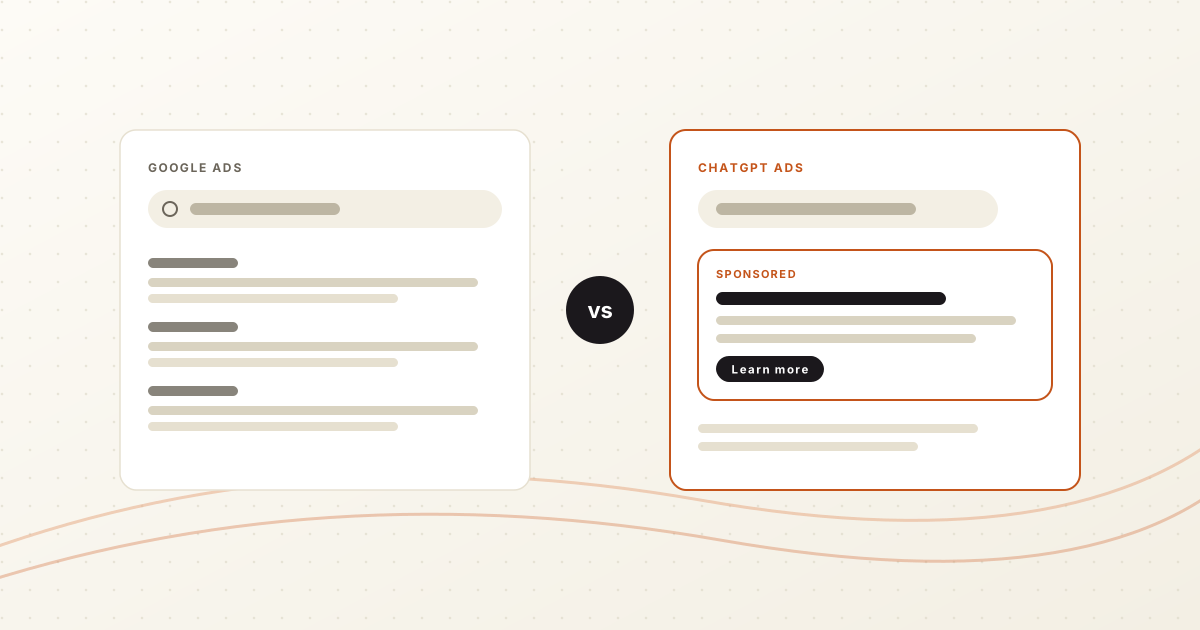
In-conversation sponsored units: a clearly labelled ad card that appears below ChatGPT's response to the user. The ad is matched to the topic of the conversation, not to a keyword.
-
Product feed campaigns: for ecommerce and retail advertisers, a catalogue upload allows ChatGPT to generate individual product ads at scale, including pricing and star ratings where available.
The in-conversation format places your ad in a different context from a search results page. The user has just read a considered, conversational response from an AI. The ad that follows needs to feel relevant to that moment, not interruptive. Copy that sounds like a traditional PPC headline ("Buy Now | Free UK Delivery | 30-Day Returns") may underperform in this environment compared to messaging that connects to the exploratory nature of the conversation.
Surgelify recommendation: Treat ChatGPT Ads creative as mid-funnel content, not bottom-funnel direct response. The strongest performing creative, in our view, will address the question the user is likely to have next: "what should I do with this information?" rather than "click here to buy." This is an observation about creative strategy rather than a claim about specific performance outcomes, which OpenAI has not published at industry level.
Landing-page expectations
A user arriving from a ChatGPT conversation has typically been thinking through a topic in depth. A landing page that simply restates a product feature list may not match their state of mind.
Surgelify recommendation: consider landing pages that acknowledge the research stage: comparison content, category guides, case studies or consultative CTAs ("speak to a specialist") tend to suit the audience better than hard transactional pages. For Google Ads, conversion-optimised pages with a clear single CTA remain the standard approach.
Cost and Budget Planning
Cost comparisons between these two channels require care. The headline CPC numbers look similar on paper, but the underlying economics are different enough that a direct comparison can mislead.
What the confirmed platform data shows
Confirmed facts, sourced from OpenAI's Ads Manager documentation and independent reporting:
| Metric | Google Ads (Search) | ChatGPT Ads |
|---|---|---|
| Minimum daily spend | No platform minimum | $25/day (self-serve) |
| Recommended starting CPC | Varies by keyword and industry | $3–5 per click (OpenAI guidance) |
| CPM (where applicable) | Varies by network | $25–60 depending on topic competitiveness |
| Bidding models | CPC, Target CPA, Target ROAS, Max Conversions | CPC, CPM, oCPC |
| Average CTR (cross-industry) | ~6.64% (Search) | ~0.9% (early data) |
| Conversion rate benchmarks | Available across industries | Not yet established cross-industry |
| Self-serve access (UK) | Available | Available from August 2026 |
Important caveats on ChatGPT Ads cost data: The platform has changed significantly since launch. The $200,000 minimum commitment from February 2026 was reduced to $50,000, then effectively eliminated for self-serve advertisers from May 2026. CPC benchmarks reported externally reflect early campaign data, not a settled market. Treat any published ChatGPT Ads cost figure as directional rather than definitive.
Why lower CPC does not automatically mean lower cost per outcome
ChatGPT Ads currently shows a lower average CPC than competitive Google Search categories, but the CTR is also substantially lower (approximately 0.9% versus 6.64% on Google Search, per early external reporting). A lower click cost combined with a lower conversion rate can produce a higher cost per qualified lead than a more expensive click on a higher-converting channel.
The correct comparison metric is cost per qualified outcome, not cost per click. The formula is straightforward:
Cost per qualified lead = cost per click ÷ landing page conversion rate ÷ lead-to-qualified rate
Surgelify observation: The businesses where ChatGPT Ads cost economics tend to work most clearly are those where Google Search CPCs are already high (competitive B2B SaaS, legal, financial services, enterprise software) and where the buyer's research process is long enough that reaching them mid-conversation has genuine value. In categories where Google Search clicks are inexpensive and conversion rates are strong, the case for ChatGPT Ads as a cost-efficiency play is weaker.
Budget planning by business stage
There is no single right budget split. The sensible approach is to treat ChatGPT Ads as a funded test funded from incremental budget, not a reallocation from proven Google campaigns.
Surgelify recommendation: Do not cut Google Ads campaigns that are already delivering profitable conversions to fund a ChatGPT Ads experiment. The risk is asymmetric: you lose proven revenue to test an unproven channel. Instead, size the ChatGPT test to reach a meaningful decision on cost per qualified outcome, then scale based on what the data shows.
A rough framework for thinking about budget readiness:
-
Under £3,000/month total paid budget: Consolidate on Google Ads. ChatGPT Ads requires enough test volume to make a meaningful decision on outcomes, and a thin budget will not get you there.
-
£3,000–£15,000/month: A modest ChatGPT Ads test (10–20% of total paid budget) is reasonable if your category suits conversational research. Keep the majority on Google for proven conversion volume.
-
£15,000+/month, particularly B2B or professional services: ChatGPT Ads warrants serious evaluation as a parallel channel, especially if Google CPCs in your category are high and your buyers make considered decisions.
Plan for a minimum of six to eight weeks per test. Early auction data is not representative, and creative iteration takes time to produce meaningful signals.
Where Google Ads Is Likely to Be Stronger
Google Ads is not the right answer for every situation, but there are categories and contexts where it holds clear structural advantages that ChatGPT Ads cannot currently match.
Categories with strong, established search demand
If your buyers already know what to search for, Google Ads intercepts that demand efficiently. Categories where this applies include:
-
Ecommerce with clear product intent (e.g. "buy noise-cancelling headphones UK", "running shoes size 10")
-
Local services with transactional queries (e.g. "emergency plumber London", "accountant near me")
-
Software with well-established category terms (e.g. "CRM software for small business", "project management tool")
-
High-volume, lower-consideration purchases where the buyer is ready to act rather than research
In these cases, the buyer has already moved past the exploration stage. They know what they want; they are looking for the best option or the most convenient supplier. Google Search captures that moment with a precision that a conversational ad environment cannot replicate.
Businesses with limited measurement maturity
Google Ads is the more forgiving platform for organisations building their measurement infrastructure. The tracking ecosystem is mature, well-documented and supported by a large community of practitioners. Conversion tracking, attribution modelling, audience segmentation and bid strategy automation are all significantly more developed than on ChatGPT Ads.
Confirmed fact: Google Ads cross-industry benchmarks show an average search conversion rate of approximately 8.18% across industries, based on data from 13,000+ campaigns measured between April 2025 and March 2026 (WordStream/LOCALiQ). No equivalent cross-industry benchmark exists for ChatGPT Ads.
Surgelify observation: For teams that are still establishing baseline conversion tracking, or that need to report performance confidently to a board or investor, Google Ads provides the measurement infrastructure to do that. ChatGPT Ads at this stage of development requires a higher tolerance for measurement ambiguity.
Tighter budgets requiring proven returns
When paid acquisition budget is limited and every pound needs to produce a trackable, accountable return, Google Ads is the more reliable starting point. The ability to test with small budgets, access established benchmarks and optimise toward proven conversion signals makes it more accessible for businesses that cannot absorb the uncertainty of a new channel.
Where ChatGPT Ads May Create a Distinct Opportunity
ChatGPT Ads is not a replacement for Google Ads, and it is not the right channel for every advertiser. But there are specific contexts where its structural characteristics create a genuine opportunity that Google Search cannot easily replicate.
High-consideration categories with long research cycles
When buyers spend significant time evaluating options before making a decision, being present during that research process has real commercial value. Categories that fit this profile include:
-
B2B SaaS and enterprise software, where procurement involves multiple stakeholders and evaluation periods of weeks or months
-
Professional services (legal, financial advisory, consultancy), where buyers compare firms carefully before engaging
-
High-ticket consumer purchases (financial products, higher education, premium travel), where the decision involves meaningful personal or financial risk
-
Categories where the buyer is not yet certain what they need, and a conversational AI is helping them define the problem before they search for a solution
In these contexts, ChatGPT Ads can reach buyers at a stage when their preferences are still forming. That is a different commercial opportunity from capturing someone who has already decided what they want.
Categories where Google CPCs are prohibitively expensive
In verticals where competitive Google Search keywords cost £30–£80+ per click (legal services, financial products, enterprise software, insurance), the CPC economics of ChatGPT Ads become more interesting, even accounting for the lower CTR. The channel is not cheap in absolute terms, but the relative cost of reaching a buyer during the research phase may be lower than the cost of competing for the same buyer at the bottom of the funnel.
Surgelify observation: This is an early-market window, not a permanent structural advantage. As more advertisers enter ChatGPT Ads, competition for relevant conversations will increase and CPCs will likely rise. The current period may offer relatively lower cost of access for categories that move quickly. We do not present this as a guaranteed cost advantage, and we would caution against making budget decisions based on the assumption that current CPC levels will persist.
Brands with strong organic AI visibility
There is a meaningful strategic advantage for brands that combine organic AI visibility (being recommended or cited by ChatGPT in organic responses) with paid ChatGPT Ads. A buyer who has already encountered a brand in an organic ChatGPT response, and then sees a relevant sponsored unit from the same brand, is in a different position from a buyer seeing the brand for the first time.
Important distinction: ChatGPT advertising and organic AI recommendations are entirely separate systems. Advertising does not influence organic responses, and organic visibility does not affect ad placement. The complementary effect comes from brand familiarity, not from any technical connection between the two.
The Role of Organic AI Visibility
Paid advertising on either platform operates independently of organic AI recommendations. But organic AI visibility, the practice of ensuring your brand appears in ChatGPT, Perplexity, Gemini and other AI systems' unpaid responses, is a distinct and complementary discipline that affects the commercial value of both paid channels.
Why organic visibility matters alongside paid activity
When a buyer uses ChatGPT to research a category, they receive an organic response before they see any sponsored unit. That organic response shapes their frame of reference: which brands are credible, which approaches are worth considering, which providers are relevant to their situation. A brand that appears consistently in organic AI responses enters paid conversations with a pre-existing level of familiarity.
This is not a theoretical effect. It follows the same logic as the relationship between organic search rankings and paid search performance: brands that appear prominently in both organic and paid positions benefit from reinforced recognition and typically see stronger paid performance as a result.
Surgelify observation: In our work with clients across B2B SaaS and professional services, we consistently find a pattern. Brands with stronger organic AI visibility, measured by citation frequency and recommendation inclusion across AI systems, tend to have a more receptive audience when paid ChatGPT activity reaches them. We present this as an observed pattern rather than a causal claim, given the limited data available at this stage of the market.
What organic AI visibility involves
Organic AI visibility, sometimes referred to as Generative Engine Optimisation (GEO), involves making a brand's content, authority signals and entity information accessible and interpretable by AI systems. Key elements include:
-
Clear, well-structured content that AI systems can accurately summarise and cite
-
Strong third-party references, coverage and citations that establish credibility
-
Structured data and technical foundations that make content easily retrievable
-
Consistent entity information across the web (what the brand does, who it serves, what problems it solves)
This work does not guarantee organic AI recommendations, and it is distinct from advertising. But it creates the conditions in which organic recommendations are more likely, and in which paid activity lands more effectively.
Decision Matrix: Which Channel Fits Your Business
Use this matrix as a starting framework, not a definitive prescription. Every business has specific circumstances that affect which channel is appropriate and at what budget level. The matrix reflects Surgelify's current assessment based on confirmed platform capabilities and observed market behaviour.
| Business type | Primary recommendation | ChatGPT Ads readiness | Key condition |
|---|---|---|---|
| Ecommerce (broad catalogue) | Google Ads (Search + Shopping) | Low, product feed format not yet widely available | ChatGPT Ads product feed campaigns are in early rollout; Google Shopping remains the established channel |
| Ecommerce (high-consideration, high-ticket) | Google Ads primary; ChatGPT Ads test | Moderate | Where buyers research extensively before purchasing (furniture, premium electronics, luxury goods), ChatGPT Ads may reach them earlier in the journey |
| B2B SaaS (SMB-focused) | Google Ads primary; ChatGPT Ads test | Moderate to high | Buyers increasingly use ChatGPT to evaluate software categories; well-suited to conversational research format |
| B2B SaaS (enterprise) | Google Ads primary; ChatGPT Ads test | High, with caveats | Long sales cycles and high Google CPCs make the ChatGPT Ads research-phase opportunity more attractive; measurement complexity requires careful setup |
| Professional services | Google Ads primary; ChatGPT Ads test | High | Legal, financial advisory, consultancy buyers are active ChatGPT research users; high Google CPCs in many sub-categories |
| Enterprise / large brand | Both channels, structured programme | High | Brand familiarity across channels matters; sufficient budget to run meaningful tests and measure incrementality |
| Local services (urgent intent) | Google Ads | Low | Urgency-driven queries ("emergency plumber", "same-day courier") are poorly suited to a conversational research environment |
| Early-stage business, limited budget | Google Ads only | Not recommended | Proven measurement infrastructure and established benchmarks are more important than channel diversification at this stage |
Three questions to apply before committing budget
Before allocating spend to either channel, answer these honestly:
-
Where is your buyer in the journey when you need to reach them? If they are already searching with a specific term, Google Ads is the right tool. If they are still working out what they need, ChatGPT Ads may be worth testing.
-
Can your measurement infrastructure support the channel? Google Ads requires conversion tracking. ChatGPT Ads requires the OpenAI Pixel and a defined standard conversion event. Neither channel should be run without measurement in place.
-
Do you have enough budget to reach a meaningful decision? A ChatGPT Ads test that runs for two weeks and produces 30 clicks is not a test. Size the budget to the decision you need to make, not to what is left over after Google Ads.
When to Use Both Channels Together
The strongest acquisition position for most businesses evaluating these channels is not a binary choice. It is a structured programme where Google Ads handles proven demand capture and ChatGPT Ads addresses the earlier research phase, with organic AI visibility supporting both.
The combined channel model
A practical combined approach works in three layers:
-
Organic AI visibility (foundation layer): Ensure your brand is findable, understandable and credible to AI systems. This is not advertising; it is the condition that makes paid activity more effective when buyers have already encountered your brand through organic AI responses.
-
Google Ads (demand capture layer): Run proven campaigns against keywords where your buyers are already searching with clear intent. Protect these campaigns; they are your conversion engine. Do not reallocate this budget to fund channel experiments.
-
ChatGPT Ads (research-phase layer): Run a funded, time-bounded test targeting conversations relevant to your category. Measure on cost per qualified outcome using the same conversion definitions as Google Ads. Scale if the data supports it; cut if it does not.
Surgelify recommendation: Set success criteria for the ChatGPT Ads test before you launch it. Decide in advance what cost per qualified lead, new-customer rate or assisted conversion threshold would justify scaling. Without pre-defined criteria, test results are interpreted subjectively, and that rarely leads to good budget decisions.
What "using both" does not mean
Running both channels does not mean splitting budget arbitrarily between them, or treating ChatGPT Ads as a like-for-like alternative to Google Search. The channels serve different moments in the buying journey. Measuring them on the same last-click conversion metric will undervalue ChatGPT Ads' contribution to earlier-stage consideration and may lead to premature decisions to cut the channel.
The right measurement approach compares channels on cost per qualified outcome, new-customer rate and, where possible, assisted conversion contribution, not on clicks, CTR or CPM in isolation.
Thinking about your channel mix for 2026? Surgelify works with ecommerce, B2B SaaS, professional services and enterprise businesses on ChatGPT Ads management, Google Ads strategy and organic AI visibility. Speak to the team about your acquisition strategy or explore our ChatGPT Ads hub to understand how the channel works before committing budget.
Published: October 2026 | Last updated: October 2026 | Last verified: October 2026 This article covers a beta platform. ChatGPT Ads features and availability change frequently. We review this content monthly.