In this guide
Key takeaways
- ChatGPT Ads creative needs to answer a specific buyer question, not just attract attention. Specificity beats promotion.
- The title, copy, image and landing page all need to match the same intent, and B2B and ecommerce campaigns need different creative cues.
- A pre-launch QA checklist reduces the risk of rejection and weak relevance.
ChatGPT Ads creative should be written as a factual, benefit-led statement that directly answers the question a user just asked. That is the single most important difference from every other paid format. The surrounding content is an AI-generated response to a real query; promotional copy that ignores that context will feel out of place and is less likely to be matched by the platform's relevance model.
This guide covers the confirmed creative requirements for ChatGPT Ads, how to align your offer with the buyer's question, common mistakes that cause rejections or poor performance, and a pre-launch QA checklist you can use before every campaign goes live.
A note on examples in this guide: The illustrative copy examples below are created to demonstrate principles. They are not live ads, verified campaign examples, or performance data from any advertiser.
What Makes ChatGPT Ads Creative Different
Display advertising competes for attention. Paid social advertising interrupts a scroll. ChatGPT Ads appear after a user has already described what they need in their own words, in a conversational exchange with an AI. That is a fundamentally different context.
Three practical implications
-
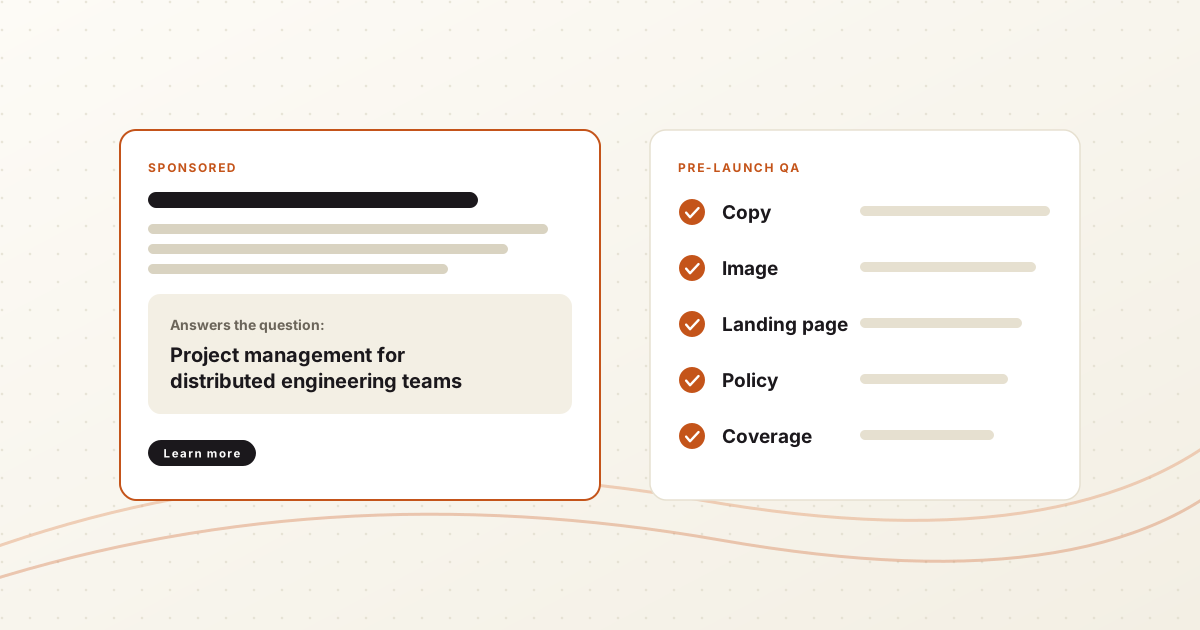
Promotional language works against you. A headline like "The UK's #1 Project Management Tool" tells the relevance model very little about what the product does or who it helps. A headline like "Project management for distributed engineering teams" is more specific and more likely to match a relevant conversation.
-
Each creative variant should introduce a distinct angle. OpenAI's guidance recommends that "each title and description variation for a given offering should introduce a different angle rather than repeating the same message." Submitting ten variations of the same claim does not improve coverage.
-
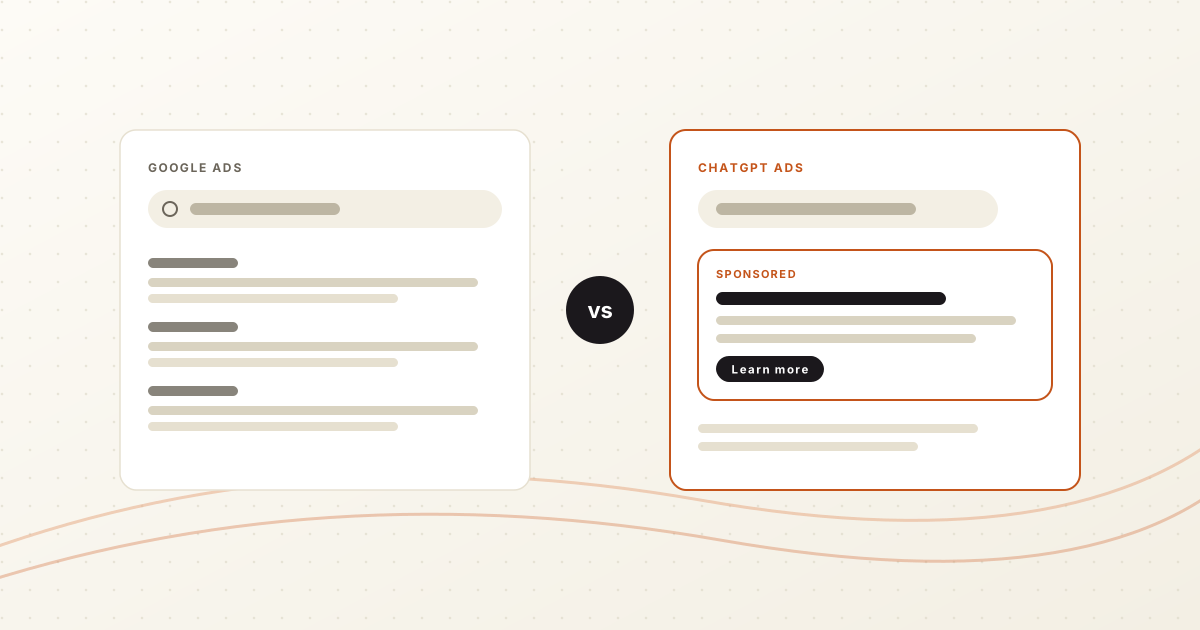
The ad is not the answer. Ads appear separately from ChatGPT's organic response and are clearly labelled "Sponsored." They do not influence the AI's answers. The creative's job is to offer a useful next step, not to compete with the response itself.
Surgelify observation: Advertisers accustomed to writing for Google or Meta often carry over habits that do not translate. Superlatives, urgency triggers, and vague benefit claims ("save time," "grow faster") are common in those environments. In a conversational AI context, specificity and accuracy are more valuable than persuasion tactics.
Creative Specifications: What the Platform Requires
The following specifications are drawn from OpenAI's published creative guidance and third-party API documentation. Specifications are subject to change; verify current limits in Ads Manager before launching.
Standard chat card (the primary format)
The chat card is the format advertisers write themselves. It appears below ChatGPT's response, clearly labelled "Sponsored," and includes the brand name, favicon, title, copy, an optional image, and a destination URL.
| Element | Maximum | OpenAI recommended range |
|---|---|---|
| Title | 50 characters | 16 to 24 characters |
| Copy (body) | 100 characters | 32 to 48 characters |
| Image | Square PNG or JPG, up to 1200 x 1200 px | Simple, relevant, aligned with the title |
| Favicon | PNG, minimum 128 x 128 px | Your brand mark |
| Destination URL | Any reachable direct URL | Must not block OAI-AdsBot or OAI-SearchBot |
Source: sprites.ai ChatGPT ad formats reference, September 2026, drawing on OpenAI's Ads API documentation.
Confirmed platform fact: OpenAI's recommended character ranges are significantly shorter than the published maximums. The observed median title length from third-party analysis is 28 characters. Writing to the recommended range, rather than the maximum, produces copy that reads cleanly in the card layout.
Product feed ads (ecommerce)
For ecommerce advertisers, a second creative type exists: the product feed ad. OpenAI builds the ad creative from a connected product catalogue; the advertiser supplies the data rather than writing the copy.
Required feed fields include: item_id, title, description, url, brand, seller_name, image_url, availability, and price. An is_ads_eligible flag controls which products are included. Feed items expire after 14 days, so OpenAI recommends using a hosted HTTPS URL or automated SFTP upload rather than a static file.
Surgelify recommendation: For ecommerce campaigns, ensure your product titles and descriptions in the feed are written with the same specificity principles as manual chat card copy. The feed title becomes the ad title. A generic product name like "Blue Backpack" will match fewer relevant conversations than "Waterproof 30L hiking backpack with laptop sleeve."
Image guidance
Confirmed platform fact (OpenAI Help Centre): OpenAI advises keeping images "simple and relevant," avoiding "overly abstract or cluttered visuals," and ensuring the image aligns with the title and copy so the creative "feels cohesive."
The image is optional for chat card ads. If you include one, it should represent the product or service clearly. Stock photography, text-heavy graphics, and lifestyle imagery that does not connect to the offer are likely to weaken creative coherence.
Aligning the Offer with the Buyer's Question
The most important creative decision is not what you want to say about your product. It is what the user was asking when your ad appeared.
ChatGPT Ads are matched to conversations, not to profiles. The relevance model uses the current chat thread, the ad's title and copy, the landing page, and any context hints you have provided at the ad group level. If your creative describes a different product or use case from the conversation it appears in, it will not be a strong match regardless of how well-written it is.
Writing titles that answer the question
A useful exercise before writing a title: consider the type of question your ad is most likely to appear after. Is the user researching options ("what project management tools work for remote teams?"), comparing specific products, or ready to act ("where can I buy X")?
Illustrative examples (not live ads or verified performance data):
| Conversation context | Weaker title | Stronger title |
|---|---|---|
| Researching standing desks | "Premium Standing Desks" | "Height-adjustable desks, delivered in 5 days" |
| Comparing CRM software | "Try Our CRM Free" | "CRM for sales teams under 20 people" |
| Looking for a project management tool | "Work Smarter Today" | "Project tracking with Gantt charts and time logs" |
The stronger titles in each case answer an implicit question: what is it, who is it for, or what does it do specifically? The weaker titles assert value without providing information.
Writing copy that adds, not repeats
Confirmed platform fact (OpenAI Help Centre): OpenAI advises that copy should "complement the title" by adding new information rather than repeating the same message, and should "expand on the value proposition" with more detail on benefits, features, or use cases.
With 32 to 48 recommended characters for body copy, there is no space for repetition. If the title names the product category and audience, the copy should address a specific feature, a pricing signal, or a use-case detail that helps the user evaluate relevance.
Surgelify recommendation: Think of the title and copy as two different questions answered in sequence. The title answers "what is this?" The copy answers "why does it apply to me right now?" That structure uses the limited character space efficiently and gives the relevance model two distinct signals to work with.
Landing page alignment
Confirmed platform fact (OpenAI Help Centre): OpenAI's guidance states advertisers should "link to the most relevant destination" using product pages, collections, or content pages rather than a generic homepage, and should "create a seamless path to action."
A mismatched landing page is one of the most common causes of poor campaign performance. If the ad title mentions a specific product category and the destination is a homepage, the user has to do additional work to find what was advertised. That friction reduces the likelihood of conversion and may also affect ad quality assessment, since the landing page is one of the signals the relevance model uses.
Landing pages must also be technically accessible. OpenAI's user agents, OAI-AdsBot and OAI-SearchBot, must not be blocked. UTM parameters can be added directly to destination URLs for tracking.
Ecommerce vs B2B Creative Considerations
The creative challenge differs meaningfully between ecommerce and B2B advertisers, primarily because the buying journey and the type of question that triggers an ad are different.
Ecommerce creative
Ecommerce users in a buying conversation are often comparing products, asking about specifications, or looking for the best option within a price range. The creative needs to provide enough product detail to be useful at that moment.
Surgelify recommendation: For product-specific campaigns, include at least one concrete attribute in the title: a key specification, a price signal ("from £49"), a delivery promise, or a compatibility detail. Vague category claims ("great home furniture") compete poorly against specific alternatives.
For product feed campaigns, audit your catalogue titles and descriptions before connecting the feed. OpenAI builds the ad from that data, so generic or truncated product names will produce weak creative without any opportunity to edit it at the ad level.
B2B creative
B2B buyers using ChatGPT are often in a research or evaluation phase. They may be asking about use cases, comparing vendor categories, or seeking guidance on what type of solution fits their problem. The conversation is typically more exploratory than a product search.
Surgelify recommendation: B2B titles should name the audience or use case explicitly rather than asserting product superiority. "Procurement software for mid-market manufacturers" is more useful to the relevance model and to the user than "Streamline your procurement process."
Because B2B buying cycles are longer, the landing page destination matters more. A product page with no supporting information is less useful to a user who is still evaluating options than a page that explains the product, its use cases, and how to evaluate it. Consider linking to a solution-specific page or a structured comparison resource rather than a generic homepage or a pricing page.
Common Creative Mistakes
Most creative problems fall into five categories. Each can be identified and corrected before launch.
Vague offers
Copy that describes a general benefit without specifying what the product is or who it is for can look polished and still fail to help. "Grow your business with our platform" tells the relevance model very little and gives the user no reason to click.
The fix: Replace benefit assertions with product descriptions. Name the category, the audience, or a defining feature. If you cannot describe the product in 24 characters, the title is not specific enough.
Mismatched landing pages
The ad title describes one thing. The destination page is about something else, or is a generic homepage with no clear connection to the ad. This creates friction for the user and weakens the coherence signal the platform uses for matching.
The fix: Every ad creative should have a corresponding destination that delivers on the title's implicit promise. If the title mentions a specific product, the landing page should be that product's page. If the title mentions a use case, the landing page should address that use case directly.
Unsupported claims
Superlatives ("the most powerful") are prohibited under OpenAI's Ad Policies. Unverifiable comparisons ("better than the competition") and outcome guarantees ("guaranteed results") are also prohibited. The policy requires ads to be truthful and not misleading, so these claims risk rejection during review.
The fix: Replace claims with verifiable facts. If the product has a measurable attribute, use it. If it does not, describe what it does rather than asserting how good it is.
Weak product information (for ecommerce)
Product feed ads that draw from a catalogue with incomplete or generic titles and descriptions. Missing price, availability, or brand information can prevent products from being eligible to serve.
The fix: Audit the feed against OpenAI's required fields before connecting it. Ensure title, description, availability, and price are populated accurately for every product you intend to advertise.
Ignoring category restrictions
Confirmed platform fact: During the initial rollout, ads are primarily limited to consumer verticals including lifestyle and household goods, local services, travel and experiences, and digital products or education. Financial services, healthcare, and legal services are available to approved advertisers only, reviewed case by case. Alcohol, gambling, adult content, political advertising, and several other categories are currently prohibited.
Submitting creative for a restricted category without prior approval will result in rejection. Categories that are currently disallowed include dating services, tobacco and alcohol, gambling, and political content. Check the OpenAI Ad Policies page for the current list before building creative for any regulated or sensitive vertical.
Pre-Launch Creative QA Checklist
Use this checklist before submitting any ChatGPT Ads creative for review. It covers the most common causes of rejection and poor post-launch performance. Save a copy and complete it for each ad group.
COPY
-
Title is 50 characters or fewer (ideally 16 to 24)
-
Body copy is 100 characters or fewer (ideally 32 to 48)
-
Title describes what the product is, who it is for, or what it does specifically
-
Body copy adds new information; it does not repeat the title
-
No superlatives, unverifiable comparisons, or outcome guarantees
-
No claims about capabilities, pricing, or affiliations that cannot be verified
-
Language is straightforward and easy to understand quickly
IMAGE (if used)
-
Image is square (PNG or JPG), no larger than 1200 x 1200 px
-
Image clearly represents the product or service
-
Image is not abstract, cluttered, or text-heavy
-
Image is consistent with the title and copy
LANDING PAGE
-
Destination URL links to a specific product, category, or solution page, not a homepage
-
The landing page content matches the ad's title and copy
-
The page is accessible and loads correctly
-
OAI-AdsBot and OAI-SearchBot are not blocked in robots.txt or server configuration
-
UTM parameters are added to the destination URL for tracking
POLICY
-
The advertised product or service falls within an approved category (OpenAI Ad Policies)
-
If the category is restricted (financial services, healthcare, legal), approval has been confirmed before submission
-
The ad does not promote alcohol, tobacco, gambling, adult content, or political content
-
Creative is consistent end-to-end: the ad and landing page do not introduce disallowed content
COVERAGE
-
At least three to five distinct title and copy combinations have been created per ad group
-
Each variation introduces a different angle (audience, use case, feature, or price point)
-
Context hints at the ad group level describe the conversations, topics, or situations where the product is relevant
ECOMMERCE FEED (if applicable)
-
All required feed fields are populated:
item_id,title,description,url,brand,seller_name,image_url,availability,price -
is_ads_eligibleis set correctly for each product -
Feed is hosted at a stable HTTPS URL or configured for SFTP to avoid the 14-day expiry issue
-
Product titles in the feed are specific enough to match relevant conversations
Surgelify recommendation: Run this checklist at the ad group level, not just the campaign level. Creative problems are most often found at the individual ad level, and a single non-compliant creative can delay review for the whole ad group.
If you are managing ChatGPT Ads for the first time or scaling an existing account, Surgelify's ChatGPT Ads management service covers creative strategy, QA, and ongoing optimisation. You can also read our overview of how ChatGPT Ads work for broader context on targeting, bidding, and campaign structure.
Published: October 2026 | Last updated: October 2026 | Last verified: October 2026 This content covers a live advertising platform. Creative specifications and policy details are reviewed monthly.