In this guide
Key takeaways
- Ranking well proves you are discoverable. It does not put you in the AI consideration set.
- Google ranks pages. AI engines construct answers, and different signals decide inclusion.
- Five gaps most commonly keep well-ranked brands out of AI recommendations.
- Some SEO work does transfer, and the guide sets out what to fix first.
Your brand ranks on page one. You have invested years in technical SEO, content, backlinks, and a site that Google clearly understands. Then a colleague types your category into ChatGPT and asks for a recommendation. Your brand does not appear. A competitor you have never considered a serious threat is mentioned by name. You ask the question that most marketing leaders are now asking: why?
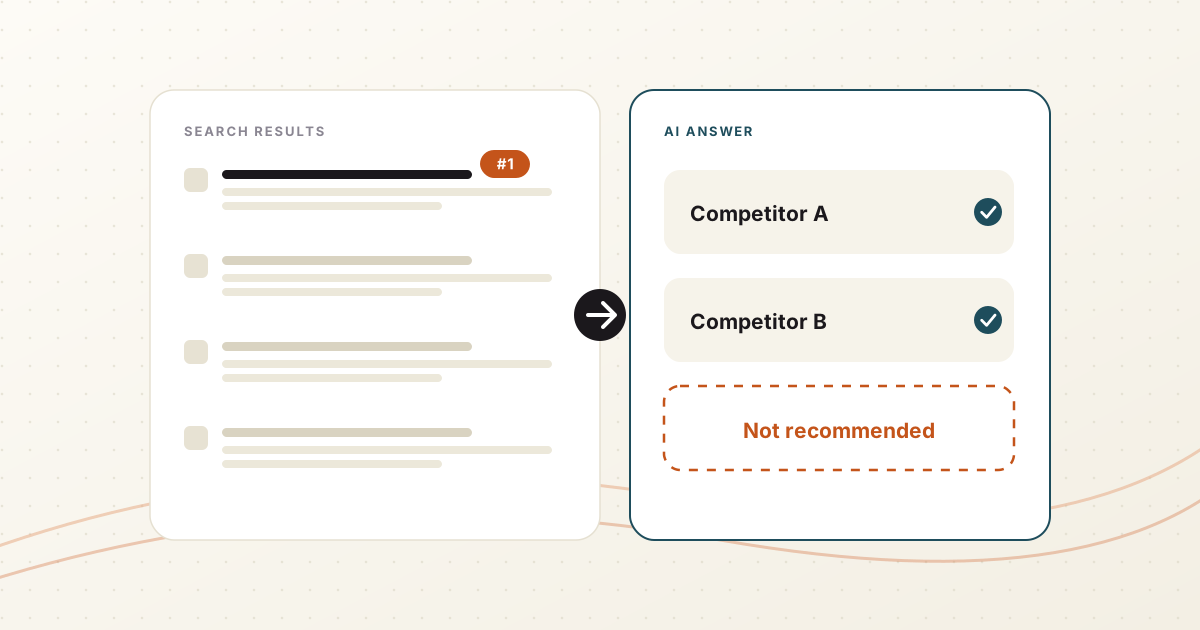
The instinct is to treat this as an SEO problem. It is not. Google rankings and AI recommendations are produced by fundamentally different systems, evaluating fundamentally different signals. Strong search performance proves that you are discoverable. It does not prove that you are recommendable.
The real question is not "why am I not ranking in AI?" It is "why am I not entering the AI consideration set?"
That reframe matters because it changes what you fix. This guide explains how AI engines decide what to recommend, which of your existing signals carry weight, and the five gaps that most commonly prevent well-ranked brands from appearing in ChatGPT, Perplexity, and Google's AI Overviews. It ends with a clear view of what to address first.
How AI Engines Actually Work (And Why It Is Nothing Like Google)
To understand the gap, you need to understand the retrieval process. Google and AI engines are solving different problems.
Ranking pages vs constructing answers
Ranks pages
- Evaluates hundreds of signals across your site and the wider web
- Output is a ranked list of links
- The user decides what to click
Construct answers
- Synthesise from training data, retrieval and entity understanding
- Output is a recommendation, not a ranking
- Weigh credibility, relevance and how well understood you are
What Google is doing
Google's job is to rank pages. When someone searches a query, Google's systems evaluate hundreds of signals across your site and the wider web to determine which pages are most relevant and trustworthy for that specific query. The output is a ranked list of links. The user decides what to click.
Your on-site signals, technical structure, backlink profile, and content quality all feed into that ranking decision. Perform well enough across those dimensions and you appear. The relationship between input and output is relatively transparent.
What ChatGPT and AI engines are doing
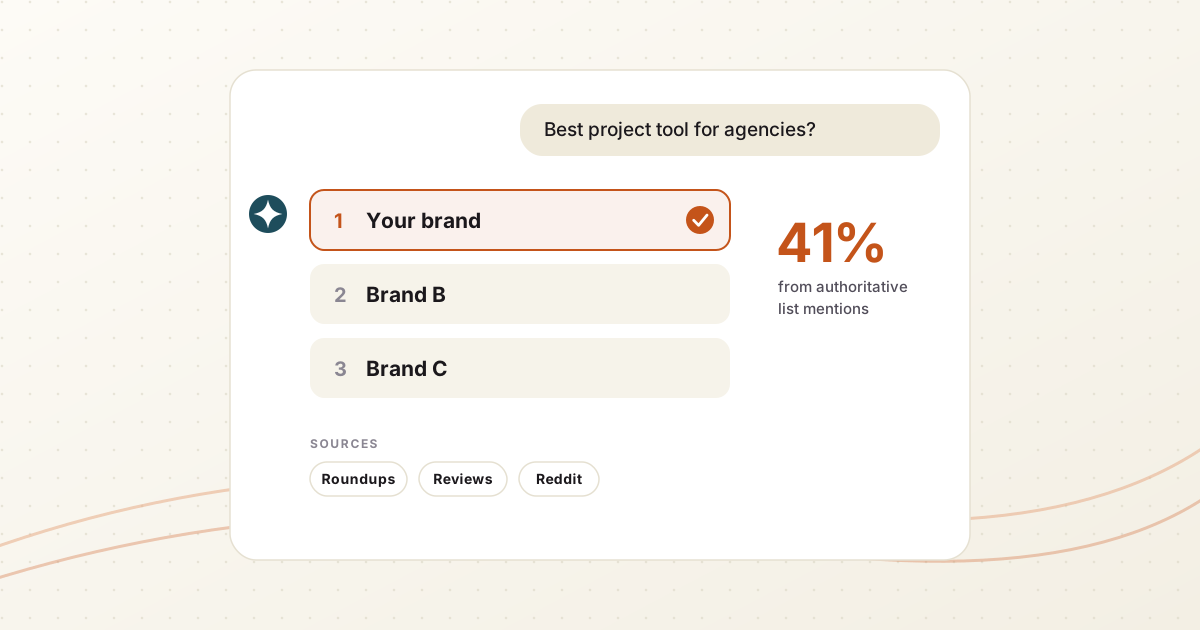
AI engines are not ranking pages. They are constructing answers. When a user asks ChatGPT "what's the best project management software for a 50-person agency?", the model does not return a list of links. It synthesises a response from its training data, its retrieval layer (where live search is available), and its understanding of the entities involved in the question.
The output is a recommendation, not a ranking. And the factors that determine whether your brand is included in that recommendation are meaningfully different from the factors that determine whether your page ranks.
According to OpenAI's documentation on ChatGPT Search, the system retrieves content from across the web to inform responses, but the synthesis layer applies its own judgement about which sources and entities are credible, relevant, and well-understood enough to recommend.
| Signal type | Google Search | AI Recommendation |
|---|---|---|
| On-page keyword relevance | High weight | Low weight |
| Technical crawlability | High weight | Moderate weight |
| Backlink authority | High weight | Partial transfer |
| Entity clarity and definition | Moderate weight | Very high weight |
| Off-site narrative consistency | Low weight | Very high weight |
| Structured data and schema | Moderate weight | High weight |
| Third-party citations and reviews | Low weight | Very high weight |
The table above is the core of the problem. The signals Google rewards most heavily (keyword relevance, technical structure, backlinks) are not the signals AI engines weight most heavily. The signals AI engines rely on most (entity clarity, off-site narrative, third-party citations) are precisely the signals most SEO programmes have historically underinvested in.
What Does Transfer from Google to AI Visibility
Not everything is lost. Some of what you have built for Google does carry genuine weight in AI systems. Understanding what transfers helps you avoid rebuilding from scratch and focus effort where the gap is real.
What carries over
-
Domain authority and backlink credibility. A strong, editorially earned backlink profile signals that your brand is a recognised entity on the web. AI retrieval systems do use this as a proxy for credibility, though it is not sufficient on its own.
-
Content depth on core topics. If you have built substantive, well-structured content across your primary subject matter, AI models are more likely to have encountered and indexed that expertise. Thin content that ranked through technical optimisation alone transfers poorly.
-
Technical crawlability. Pages that are cleanly crawlable, fast, and free of structural errors are more likely to be retrieved and processed by AI systems that pull live web content. This is a floor condition, not a differentiator.
-
Brand name recognition in the training corpus. If your brand has been mentioned, reviewed, and discussed across the web over time, that presence feeds into the model's understanding of who you are. Brands with a long, consistent digital footprint have an advantage here.
What does not transfer
The critical gap: Google rewards the page. AI rewards the entity. Most SEO programmes have optimised the page without ever systematically building the entity.
An entity, in the context of AI systems, is a clearly defined, machine-readable understanding of what your brand is, what it does, who it serves, what problems it solves, and how it is positioned relative to alternatives. If that understanding is absent, incomplete, or inconsistent across the web, AI engines cannot confidently recommend you, regardless of how well your pages rank.
This is why brands with mediocre Google performance sometimes appear in AI recommendations ahead of well-ranked competitors. They have a clearer entity footprint. The AI system understands them.
The Five Gaps That Keep Well-Ranked Brands Out of AI Recommendations
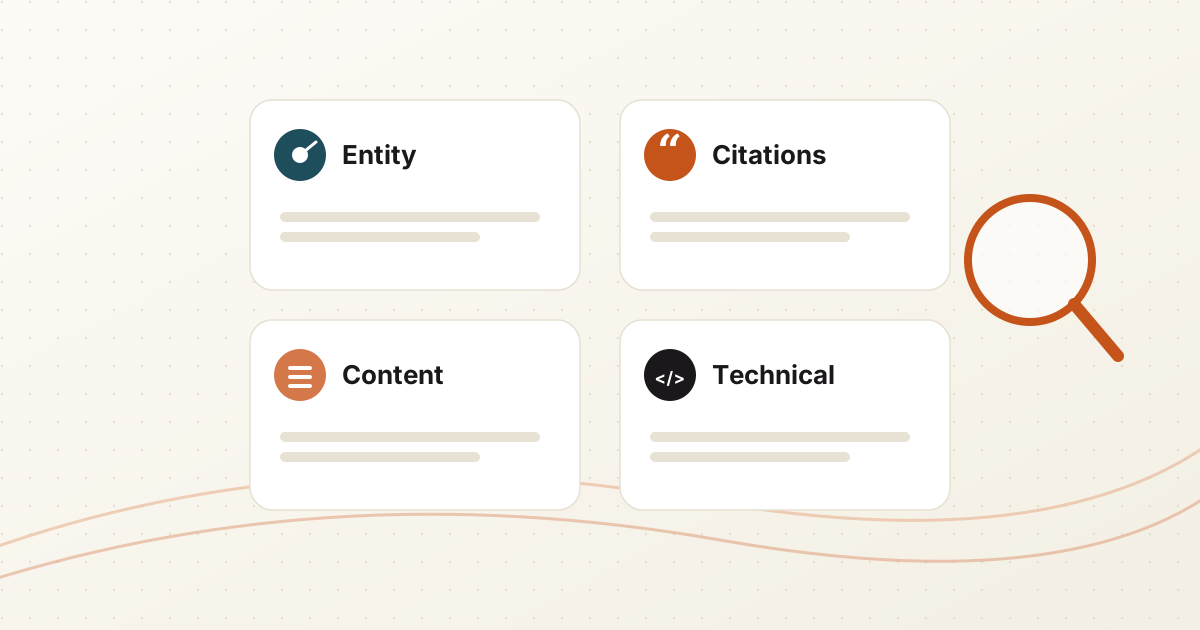
Across the brands that come to Surgelify with this problem, five gaps appear consistently. They are rarely present in isolation. Most brands have three or four of them simultaneously, which is why fixing one thing rarely produces visible results.
Gap 1: Entity ambiguity
AI systems build their understanding of your brand from every signal available to them: your website, your structured data, third-party descriptions, press coverage, review platforms, directories, social profiles, and the language used about you across the web. When those signals are inconsistent, the model cannot form a confident, coherent picture of what you are.
Common symptoms include:
-
Your brand name is associated with multiple unrelated categories across different platforms
-
Your positioning language changes significantly between your website, your LinkedIn profile, and your Google Business Profile
-
Structured data is absent or describes your organisation in generic terms
-
Wikipedia or Wikidata has no entry for your brand (significant for larger organisations)
An AI system that cannot confidently define your entity will not confidently recommend it. Ambiguity is treated as a risk signal, not a neutral condition.
Gap 2: Weak off-site narrative
Your website may articulate your positioning clearly and convincingly. The problem is that AI engines do not form their view of your brand exclusively from your own site. They synthesise from the entire web. If the narrative about your brand that exists across external sources is thin, outdated, or absent, your self-description carries limited weight.
Off-site narrative includes: press coverage, analyst mentions, industry publication features, podcast appearances, forum discussions, review platform content, and third-party comparisons. Brands that have invested primarily in on-site content whilst neglecting earned media and third-party presence have a significant AI visibility deficit, even when their own content is excellent.
Gap 3: No presence in the sources AI engines trust
Not all sources carry equal weight. AI retrieval systems draw more heavily from sources that are themselves authoritative, frequently updated, and structurally clear. Google's guidance on helpful, reliable content provides a useful proxy for understanding what AI systems also tend to value: content that demonstrates first-hand expertise, trustworthiness, and genuine usefulness.
If your brand is not mentioned in the sources AI engines treat as authoritative for your category, such as established industry publications, credible review platforms like G2 or Trustpilot, and relevant professional communities, you are invisible to the retrieval layer regardless of your own site's quality.
Gap 4: Content that is written for humans but not readable by machines
This is the subtlest gap and the one most likely to surprise strong SEO teams. AI engines do not read content the way humans do. They parse it for extractable facts, clear claims, defined entities, and structured relationships. Content that is engaging, well-written, and conversion-optimised can still be largely opaque to an AI retrieval system if it lacks the structural signals that allow machine extraction.
Specific problems include:
-
Key claims buried in long paragraphs with no structural hierarchy
-
Product or service descriptions that rely on implied context rather than explicit definition
-
No schema markup to confirm entity type, service area, or offering
-
FAQ content that exists in JavaScript-rendered components rather than crawlable HTML
-
Comparison or positioning content written for emotional persuasion rather than factual clarity
AI engines are looking for clear answers to implicit questions: What is this brand? What does it do? Who does it serve? What makes it different? If your content does not answer those questions explicitly and extractably, the model fills the gap with uncertainty.
Gap 5: Absence from decision-stage conversations
Google rewards content that matches search queries. AI engines are increasingly used at a different stage: not the information-gathering phase, but the comparison and decision phase. Buyers ask ChatGPT things like "which is better for a mid-market B2B company: [Option A] or [Option B]?" or "what are the main alternatives to [category leader]?"
If your brand has no content that positions it clearly within those comparison and decision-stage conversations, and no off-site presence in the places where those comparisons happen (review platforms, community forums, analyst reports), you will not enter the AI consideration set at the moment that matters most commercially.
Key insight: The consideration set is formed before the buyer visits your website. If you are not in the AI's answer at that stage, you are not in the buyer's shortlist. You cannot recover from the decision page.
What to Fix First
The five gaps above are not equally urgent, and they do not all require the same investment to address. The sequence below reflects both impact and practicality: start with the changes that unlock the most downstream value before moving to the longer-term authority-building work.
Step 1: Audit your entity clarity
Before anything else, establish what AI systems currently understand about your brand. This means testing how ChatGPT, Perplexity, and Google's AI Overviews describe you when asked directly. Note what they get right, what they get wrong, and what they omit entirely. The gaps in those descriptions are a direct map of your entity clarity problem.
Then audit the consistency of your positioning language across:
-
Your own website (homepage, about page, service pages)
-
Your Google Business Profile
-
LinkedIn company page
-
Key directory listings and data aggregators
-
Your structured data (Organisation, LocalBusiness, or Product schema)
Inconsistencies here are quick wins. Aligning your entity definition across these sources is the fastest way to give AI systems a clearer, more confident picture of who you are.
Step 2: Implement structured data properly
Schema markup is one of the clearest signals you can give an AI retrieval system. It removes ambiguity by explicitly defining your entity type, your services, your location, your founding date, and your relationship to other entities. Many brands have schema markup in place but have implemented it at a surface level that provides minimal extractable information.
At minimum, your schema should include:
-
Organisation schema with a clear description, founding date, area served, and known-for attributes
-
Service schema for each primary offering, with explicit descriptions and target audience
-
FAQ schema on pages that answer common buyer questions
-
Review or AggregateRating schema where applicable
Google's structured data documentation provides the technical specification. The strategic objective is to make your entity unambiguous to any system parsing your pages.
Step 3: Build your off-site presence in authoritative sources
This is the highest-effort item and the one with the longest lead time, which is precisely why it needs to start early. The goal is to create a consistent, credible narrative about your brand in the sources that AI engines treat as authoritative.
Practical starting points include:
-
Securing coverage in established industry publications relevant to your category
-
Building a substantive presence on G2, Trustpilot, or sector-specific review platforms
-
Participating in relevant professional communities where your buyers discuss options (LinkedIn groups, industry forums, Reddit communities)
-
Pursuing analyst mentions, award listings, or accreditations that carry independent credibility
-
Updating any Wikipedia or Wikidata entries where your brand qualifies for inclusion
None of these are fast. But collectively they build the off-site narrative that AI systems synthesise into their understanding of your brand's credibility.
Step 4: Restructure your content for machine extraction
Review your highest-value pages with a single question in mind: can an AI system extract a clear, factual answer to "what does this brand do and why should I recommend it?" from this page?
If the answer is no, the content needs structural work, not a complete rewrite. This typically means:
-
Adding explicit definition paragraphs at the top of service pages
-
Breaking long paragraphs into structured claims with clear subject lines
-
Adding FAQ sections in crawlable HTML that address the comparison and decision questions your buyers ask
-
Making competitive positioning explicit rather than implied
Step 5: Create decision-stage content
Finally, build content that enters the conversation at the moment AI engines are most commercially useful: the comparison and shortlisting stage. This means producing content that directly addresses questions like:
-
"[Your brand] vs [competitor]: which is right for [specific use case]?"
-
"Best [category] for [specific audience segment]"
-
"What to look for when choosing a [category] provider"
This content serves two purposes simultaneously. It signals to AI engines that your brand belongs in decision-stage conversations. And it creates pages that can rank in traditional search for high-intent, commercial queries.
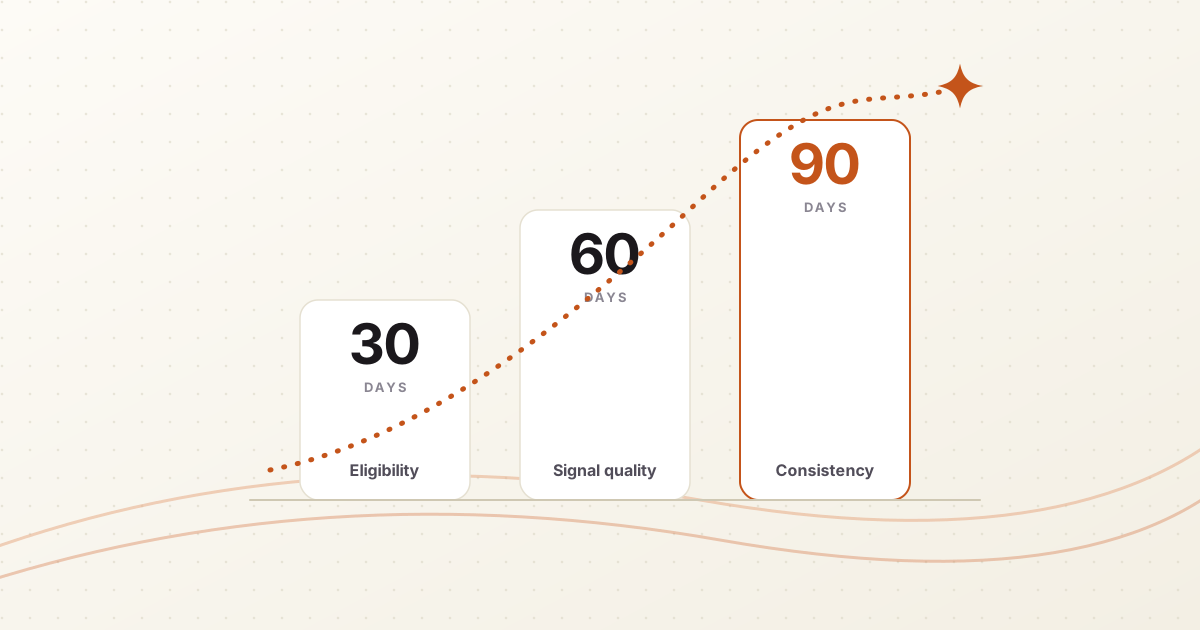
Priority order: Entity clarity and schema are weeks. Off-site narrative is months. Both are necessary. The brands that appear consistently in AI recommendations have done both, not one or the other.
The Competitive Reality
The brands appearing in AI recommendations right now are not necessarily the best in their category. They are the most legible to AI systems. They have entity clarity, off-site narrative depth, structured data, and decision-stage content. Many of them have weaker Google rankings than the brands they are displacing in AI-generated shortlists.
That gap will not persist indefinitely. As more marketing teams understand the distinction between search discoverability and AI recommendability, the competition for inclusion in AI consideration sets will intensify. The brands that build their AI visibility infrastructure now will be harder to displace later.
The question is not whether this matters. It is whether you address it before your competitors do.
If you have strong Google SEO and limited AI visibility, you have a specific, diagnosable problem. The signals exist. The gaps are identifiable. The fixes are sequenceable. What most brands lack is not the capability to address this but a clear view of exactly where they stand and what to prioritise.
Surgelify works with marketing leaders to audit AI visibility gaps, build entity clarity, and develop the off-site authority needed to enter AI consideration sets consistently. If you want to understand precisely where your brand stands and what needs to change, book a strategy consultation.