In this guide
Key takeaways
- Meaningful AI visibility is a 90-day evidence exercise, not a 30-day ranking event.
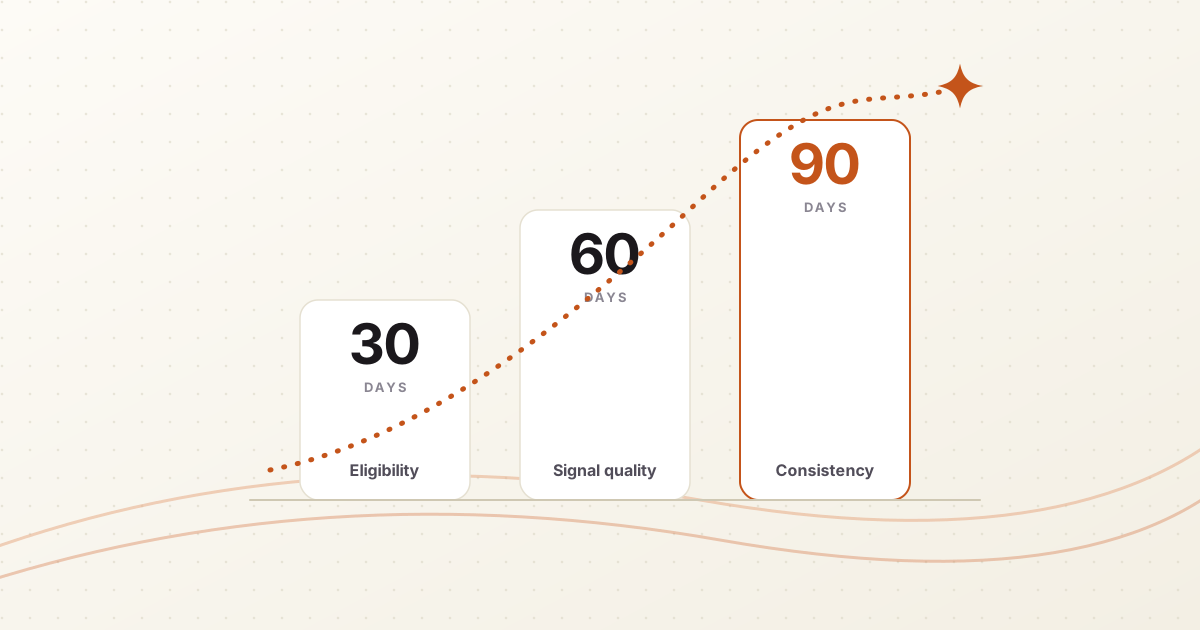
- Month one establishes eligibility, month two builds signal quality, and month three shows whether AI systems are starting to select you.
- At day 90, look for rising citation frequency, commercially relevant queries and the optimised content being the content that is cited.
When a marketing leader asks how long organic AI placement takes, they are rarely asking out of curiosity. They are asking because budget is on the table, a retainer is being proposed, and someone in the room wants to know what they will have to show for it in 90 days.
That is the right question. It is also one that most agencies answer badly, either by overpromising early wins or by retreating into vague statements about "long-term brand building" that conveniently defer accountability indefinitely.
The honest answer is this: meaningful AI visibility is a 90-day evidence exercise, not a 30-day ranking event. The first month establishes eligibility. The second builds signal quality. The third begins to show whether AI systems are starting to select you more consistently. None of that is a guarantee of placement. All of it is commercially measurable.
This guide explains what to expect at each stage, what accelerates progress, what stalls it, and how to measure whether the work is producing results worth continuing to fund.
Why the Timeline Question Is Really a Budget Question
Organic AI placement sits in an uncomfortable position for most marketing budgets. It does not behave like paid search, where spend produces near-instant visibility. It does not behave like traditional SEO, where rankings are at least trackable on a weekly basis. AI systems such as ChatGPT, Google AI Overviews and Perplexity select sources based on a combination of relevance, authority, recency and the specific query context, and that selection logic is not fully transparent.
This matters for budget decisions because the standard agency sales narrative, "you will start appearing in AI answers within weeks," collapses two different things into one claim. Being crawled and understood by AI systems is achievable relatively quickly. Being consistently selected in response to commercially relevant queries is a different challenge entirely, and it takes longer.
Research from Washington University's analysis of Google AI Overviews found that AI-generated results appeared in only 13.7% of 55,393 searches studied, and that question-form queries triggered overviews far more often, at nearly 65% of the time. Critically, 29.8% of cited domains were not present on the first page of traditional search results. That last figure is important: AI source selection is not simply a replication of your existing rankings. It follows its own logic, and that logic rewards content clarity, evidential authority and structural accessibility.
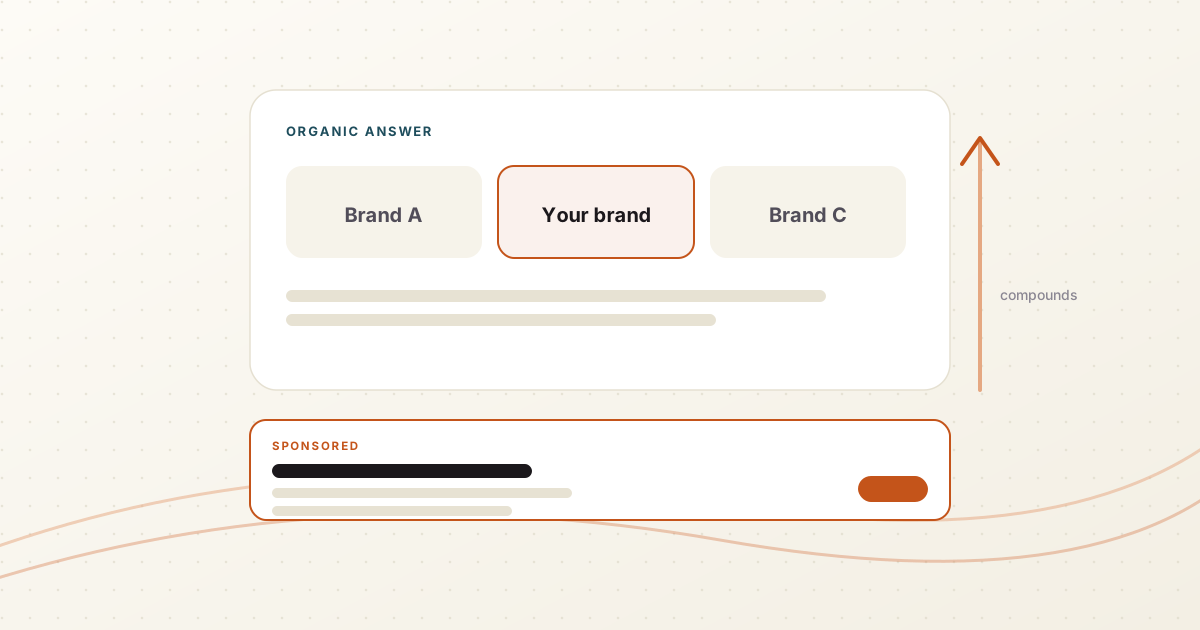
What this means for budget owners: You are not buying a ranking. You are investing in the conditions that make AI systems more likely to select you. The first 90 days should be evaluated on whether those conditions are improving, not on whether you have "won" a placement.
The 30-60-90 Day Evidence Model
Think of the first three months not as a countdown to guaranteed results, but as three distinct stages of evidence accumulation.
Three stages of evidence
Establishing eligibility
Technical access, entity clarity, content eligibility and a baseline measurement.
Building signal quality
Answer-led content, evidential density and stronger external authority.
Measuring consistency
Citation frequency, query relevance, consideration-set inclusion and traffic signals.
Days 1 to 30: Establishing Eligibility
The first month is diagnostic and structural. AI systems cannot select content they cannot access, understand or trust.
Work in this stage typically includes:
-
Technical accessibility: Ensuring key pages are crawlable and not blocked by JavaScript rendering issues or restrictive crawl directives
-
Entity clarity: Making it unambiguous to AI systems what the business does, who it serves, and what problems it solves, through structured data and consistent entity signals
-
Content eligibility: Identifying which existing pages AI systems can extract and cite, and which need restructuring
-
Baseline measurement: Documenting what AI systems currently say about the business and competitors, so future changes can be measured
At day 30, the question is not "are we appearing in AI answers?" It is: "Have we removed the barriers that were preventing AI systems from understanding and trusting us?"
Days 31 to 60: Building Signal Quality
With structural foundations in place, the second month focuses on the quality and density of signals that AI systems use to evaluate source credibility.
Research on generative engine optimisation, including the GEO paper published on arXiv, found that certain content attributes materially improve source inclusion likelihood: cited statistics, quotations from authoritative sources, and direct answers to the questions being asked. In benchmark conditions, optimised content showed visibility improvements of up to 40% compared to unoptimised equivalents.
Work in this stage typically includes:
-
Publishing or restructuring content to directly answer the queries where inclusion is being targeted
-
Adding evidential density: statistics, expert references and structured claims that give AI systems something concrete to extract
-
Strengthening external authority signals through third-party mentions and consistent brand references across credible domains
-
Monitoring whether baseline AI responses have begun to shift
Days 61 to 90: Measuring Consistency and Commercial Relevance
The third month is where budget validation becomes possible. What to look for:
-
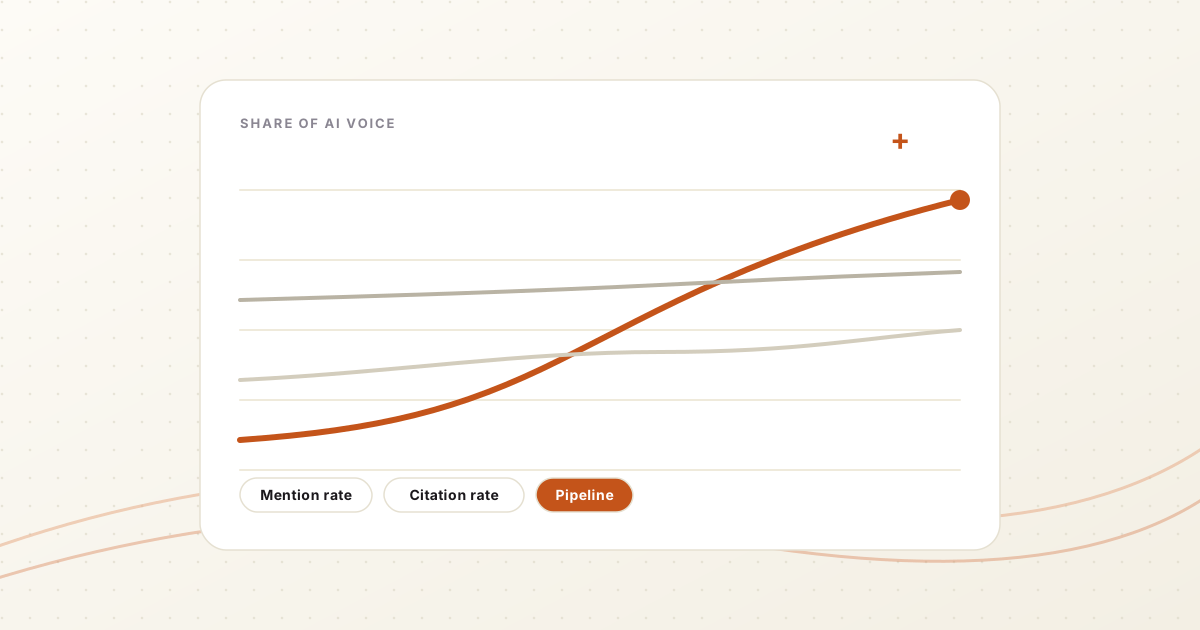
Increased citation frequency: Are AI systems referencing the business more often across a broader range of relevant queries?
-
Query relevance: Are the queries driving citation commercially relevant, or peripheral to actual buyer journeys?
-
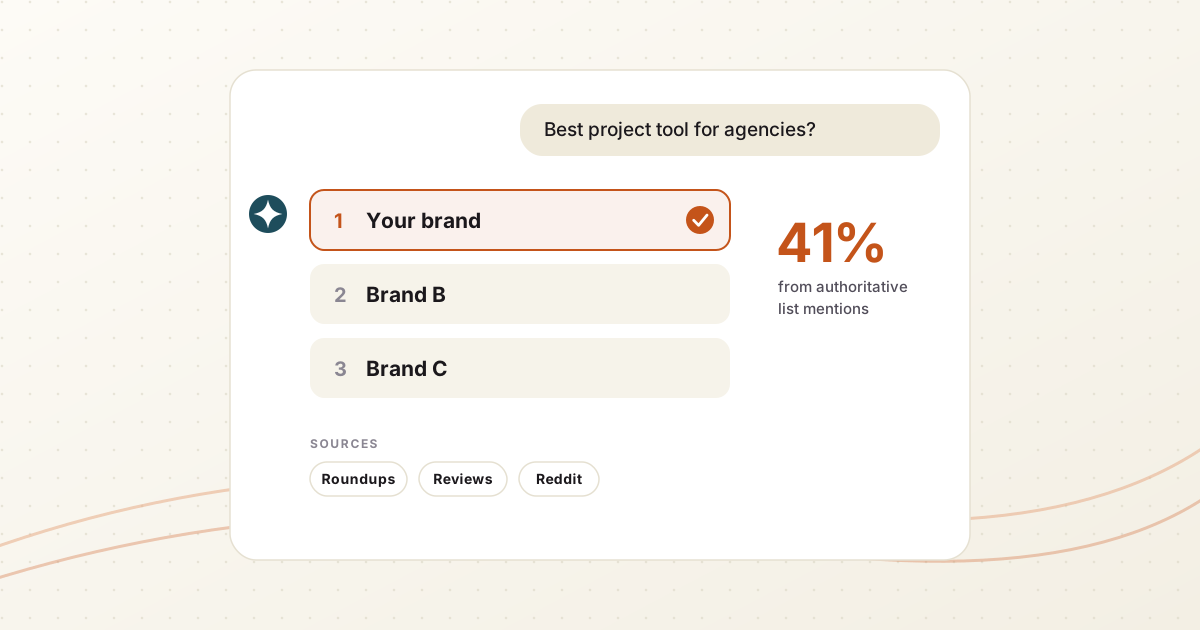
Consideration-set inclusion: When AI systems are asked to recommend or shortlist providers in your category, are you appearing?
-
Traffic signals: Is there measurable referral traffic arriving from AI sources, even if modest at this stage?
At day 90, the honest evaluation is this: if citation frequency is trending upward, the queries are commercially relevant, and the content being cited is the content that was optimised, the investment has produced credible early evidence. That is a sound basis for continuing. If none of those signals are present, the diagnosis matters more than the continuation.
What Accelerates Results and What Stalls Them
Not all starting positions are equal. Two businesses investing the same budget in organic AI visibility will often see materially different timelines, and the gap is almost always explained by a handful of factors.
What accelerates progress
| Factor | Why it matters |
|---|---|
| Existing domain authority | AI systems prioritise sources that are already recognised as credible. A site with strong inbound links and established topical authority will see eligibility improvements faster. |
| Clear entity definition | Businesses with consistent, unambiguous descriptions across their website, third-party profiles and industry directories are easier for AI systems to understand and reuse. |
| Structured, extractable content | Pages written with direct answers, clear headings, and verifiable evidence give AI systems something concrete to cite. Dense, unstructured prose is harder to extract. |
| Active publishing cadence | OpenAI's web search documentation confirms that models are guided to prioritise reliable and up-to-date sources. Fresh, relevant content increases recency signals. |
| Targeted query selection | Focusing on a narrow set of high-intent queries in the first 90 days produces cleaner evidence than trying to appear across every possible search. |
What stalls progress
-
Technical barriers: Pages that are blocked from crawling, rendered entirely in JavaScript without server-side fallback, or buried behind login walls cannot be selected regardless of content quality
-
Thin or generic content: Content that does not directly answer specific questions, lacks evidence, or is indistinguishable from hundreds of similar pages will not be prioritised
-
Inconsistent brand signals: If the business is described differently across its own website, LinkedIn, industry directories and third-party mentions, AI systems struggle to construct a coherent understanding of what it does
-
Overly broad targeting: Attempting to appear in AI answers for every relevant query simultaneously dilutes effort and makes progress harder to measure and attribute
-
Slow content review cycles: Organic AI visibility requires iterative content development. Long internal approval processes delay the feedback loop and slow momentum
The authority signals that underpin AI inclusion are not fundamentally different from those that have always driven search credibility. What has changed is how those signals are weighted and applied when an AI system constructs a response rather than returning a list of links.
Realistic Expectations vs Common Agency Overclaims
The organic AI visibility market is young enough that overclaiming carries little short-term risk for the agencies doing it. Most clients do not yet have the measurement infrastructure to disprove a vague promise, and the complexity of AI source selection makes attribution genuinely difficult.
The claims worth being sceptical of include:
-
"You will appear in ChatGPT within 30 days" - Appearance in AI answers depends on crawlability, query context, and competitive authority. Thirty days is enough time to improve eligibility, not enough time to guarantee consistent selection.
-
"We guarantee AI citations" - No agency controls the decisions of AI systems. OpenAI's own guidance confirms that source selection considers relevance, diversity and trustworthiness, all of which are influenced by the work but not determined by it.
-
"Our proprietary system gets you ranked in AI" - AI source selection is not a ranking system in the traditional sense. It is a relevance and credibility evaluation that varies by query. There is no fixed position to buy or hold.
-
"Results in weeks, not months" - Early signals can appear within weeks. Consistent, commercially relevant inclusion typically takes three to six months, depending on starting authority and the competitiveness of the target queries.
What a credible provider should offer instead is a clear methodology, a documented baseline, measurable leading indicators at each stage, and an honest account of what they can influence versus what they cannot control. Budget validation requires measurement, not promises.
Start With a Strategy Session, Not a Retainer
The most common mistake marketing leaders make when evaluating organic AI visibility is committing to a full retainer before establishing whether the fundamentals are in place. A strategy session first answers the questions that matter before budget is released: what is your current AI eligibility score, which queries represent the most commercially valuable opportunity, what is your starting position relative to competitors, and what would credible progress look like in your specific market?
Surgelify's strategy consultations are designed to answer exactly those questions, without the pressure of a pre-committed programme. If the opportunity is real and the conditions are right, the case for investment will be evident. If significant groundwork is needed first, you will know that before spending on a retainer.
Book a strategy consultation with Surgelify and get a clear picture of where you stand, what is achievable in 90 days, and what evidence you should expect to see before committing further budget.