In this guide
Key takeaways
- Five signals stand out: authoritative list mentions, third-party review presence, entity consistency, content structure for extraction, and Bing visibility with crawler access.
- ChatGPT mentions brands 3.2 times more often than it cites them with links, so a link-only strategy misses most of the opportunity.
- A useful benchmark is your brand name on at least 15 to 20 unique trusted domains.
- Measure with a prompt set of 20 to 30 queries and track share of mention monthly.
The Five Signals That Drive ChatGPT Recommendations
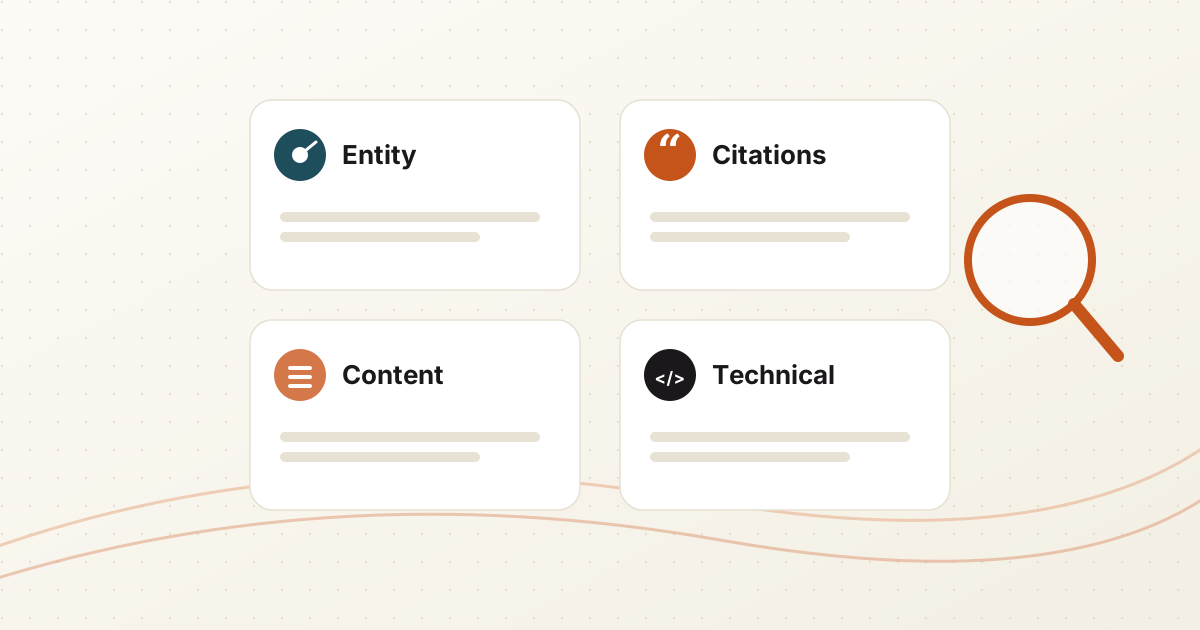
Multiple independent studies published in 2025 and 2026 have mapped the signals that consistently predict whether a brand appears in AI recommendations. Five stand out as the highest-leverage levers.
The numbers behind the signals
of recommendations tied to authoritative list mentions
citation probability with third-party review presence
more brand mentions than linked citations
unique trusted domains to aim for before consistent recommendations
prompts in a baseline set for measuring visibility
Figures as cited in the guide below.
Signal 1: Authoritative list mentions (41% of recommendations)
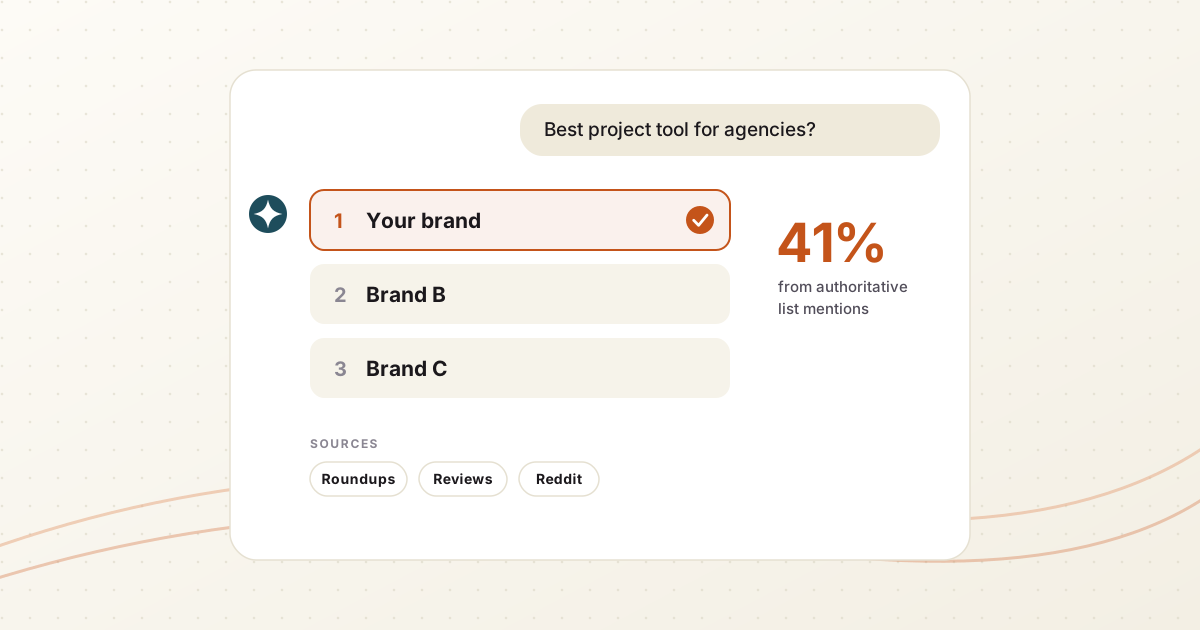
The most influential factor is whether your brand appears in "best of" lists, industry rankings, and expert roundups on authoritative sites. Research from Onely found authoritative list mentions account for 41% of ChatGPT commercial recommendations. No other signal comes close.
This is not the same as backlinks. A link from a low-quality directory does almost nothing. A mention in a comprehensive industry roundup on a respected publication creates a strong contextual association between your brand and your category.
What to do: Run category queries in ChatGPT and note which sources it cites. Identify the 10 to 20 publications that appear repeatedly. Those are your priority media targets. Pitch expert commentary, contribute data to roundup pieces, and pursue inclusion in annual "best of" lists in your space.
Signal 2: Third-party review presence (3x citation probability)
Domains with active profiles on Trustpilot, G2, Capterra, or Yelp have 3x higher citation probability than those without. ChatGPT treats review platform presence as a proxy for legitimacy, not just social proof.
The substance of reviews matters too. ChatGPT reads review content, not just star ratings. Specific reviews that describe use cases and outcomes carry more weight than generic five-star ratings.
What to do: Claim and fully complete your profiles on G2, Trustpilot, Capterra, and any category-specific review platforms. Ask existing customers for detailed reviews that describe specific outcomes. Fifteen detailed reviews outperform two hundred generic ratings.
Signal 3: Entity consistency across the web
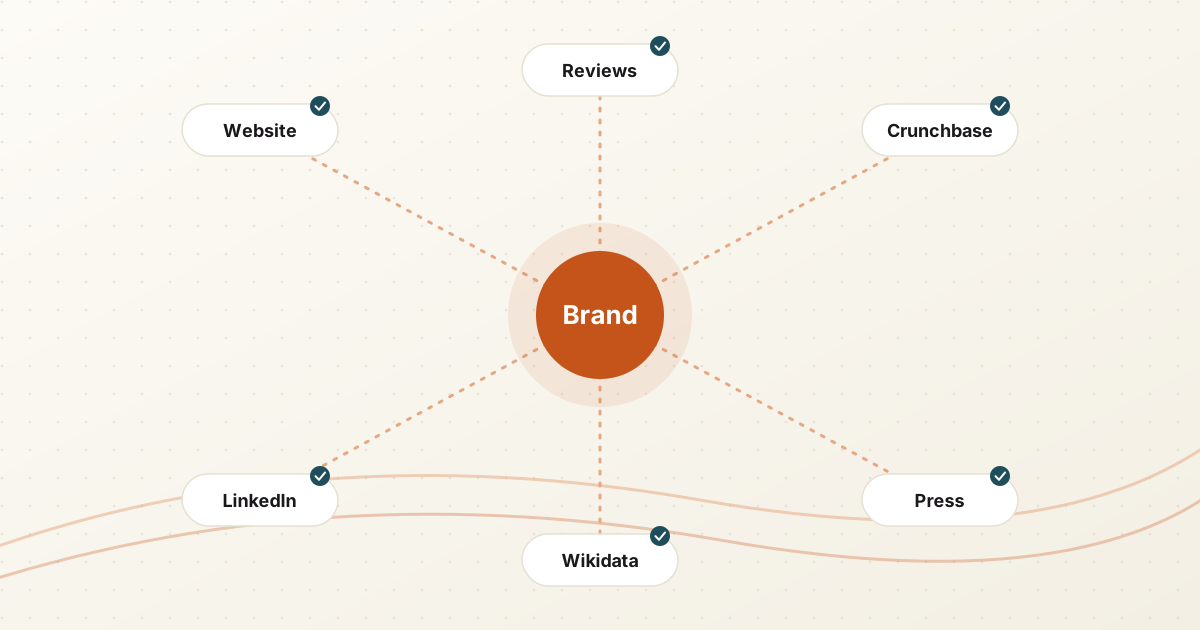
Before ChatGPT recommends your brand, it must recognise it as a distinct entity. AI systems build internal entity models from what they find across the web. If your name, description, and positioning are inconsistent across your website, LinkedIn, Crunchbase, and press mentions, the model experiences what researchers call "entity resolution noise."
Brands with Wikidata entries, complete schema markup, and consistent name-address-phone data are recognised as clear entities. Brands without these signals get confused with competitors or ignored entirely.
What to do: Run an entity audit. Search your brand name across Wikidata, Crunchbase, LinkedIn, Google Business Profile, and your top five industry directories. Confirm that your name, description, and core offering are described consistently. Implement Organisation schema (JSON-LD) on your homepage with your full company name, description, logo, and social profiles.
Signal 4: Content structure for AI extraction
GEO-SFE research published in 2026 quantified the impact of content structure on citation behaviour across six generative engines. Structural optimisation alone, without changing semantic content, produced a 17.3% improvement in citation rates.
ChatGPT selects passages that are independently citable: self-contained, specific, and verifiable. A page that opens with a direct answer, uses question-based headings, and includes at least one data point per section is structured for extraction. A page that buries key claims in long narrative paragraphs is not.
The extractability test: Can the opening two sentences of each major section be quoted in isolation and still make complete sense? If not, restructure the section to lead with the claim before the context.
What to do: Audit your top five pages. Rewrite section openings to lead with the direct answer. Add FAQ sections with five to ten real buyer questions. Replace vague quantifiers with specific numbers. Pages refreshed within 30 days are cited 3.2x more often than stale content. Add visible "Last updated" dates and refresh key statistics quarterly.
Signal 5: Bing visibility and crawler access
Bing-indexed pages drive 87% of ChatGPT's live citations. If your site does not rank in Bing, you are not in the candidate pool for most commercial recommendation queries. Your Google rankings do not help here.
Many brands have never verified their Bing presence. Some inadvertently block AI crawlers in their robots.txt. The crawlers that matter most for ChatGPT are GPTBot, OAI-SearchBot, and ChatGPT-User.
What to do: Submit your sitemap to Bing Webmaster Tools and verify your site. Check your robots.txt for any rules blocking those three crawlers. Make sure your most important pages are server-rendered HTML. JavaScript-dependent content is often invisible to crawlers.
Building Citations That ChatGPT Actually Uses
Citation building for AI visibility differs from link building for SEO. The goal is not to accumulate links. It is to appear consistently across sources that ChatGPT already treats as credible.
ChatGPT mentions brands 3.2 times more often than it cites them with links. Brand mentions in text are the primary visibility mechanism, not hyperlinks. A link-focused strategy misses most of the opportunity.
Identify your citation pool first
Every product category has a citation pool: the 10 to 20 publications, review platforms, and community sites that appear repeatedly in ChatGPT citations when users ask about that category. To find yours:
-
Run 10 to 15 category queries your buyers would actually use in ChatGPT
-
For each response, note every source cited in the footnotes or references
-
After 10 to 15 queries, the same 8 to 12 publications will appear repeatedly
-
Those publications are your citation pool. Appearing in them is the highest-leverage activity available
Where to build citations by source type
| Source type | Examples | Priority |
|---|---|---|
| Industry review platforms | G2, Capterra, Trustpilot, TrustRadius | Immediate |
| Authoritative roundups | Trade publications, analyst reports, "best of" lists | High |
| Community platforms | Reddit (relevant subreddits), Quora | High |
| Business directories | Crunchbase, LinkedIn, Google Business Profile | Foundation |
| News and PR | Industry press, product launch coverage, expert quotes | Ongoing |
Reddit deserves specific attention. It accounts for 46.5% of Perplexity citations and carries significant weight in ChatGPT's community-validated recommendations. Genuine participation in relevant subreddits, where your brand is mentioned naturally in the context of solving real problems, is one of the most efficient citation-building activities available.
The co-mention principle
ChatGPT builds confidence when a brand appears consistently across multiple independent sources. A brand mentioned in a Forbes article, a G2 comparison, a Reddit thread, and a trade roundup is one the model can recommend with confidence.
The benchmark: your brand name should appear on at least 15 to 20 unique trusted domains before you can expect consistent organic AI recommendations.
Structuring Your Content for AI Extraction
Your own website is not the primary source ChatGPT uses to recommend your brand, but it is still a meaningful part of the evidence stack. Pages structured for AI extraction get cited. Pages that are not structured for extraction are invisible, regardless of their Google rankings.
The fundamental shift is from narrative to answer-first content. Traditional web content tells a story and builds to a conclusion. AI-extractable content states the conclusion first. Supporting context follows.
The answer-first page structure
Every page you want ChatGPT to cite should follow this pattern:
-
Opening claim (2 to 3 sentences): A direct, self-contained answer to the primary question the page addresses. This should be quotable in isolation.
-
Supporting context (1 to 2 paragraphs): The evidence or explanation that backs the opening claim.
-
Specific data point: At least one named statistic or verifiable figure per major section. Pages with specific statistics earn 25% higher citation rates than those without.
-
FAQ section: Five to ten real buyer questions with direct answers. FAQ sections are among the most-cited page elements across all AI engines.
The five pages to prioritise
Before restructuring every page on your site, focus on these five:
-
Your core product or service category page
-
Your key comparison page ("X vs Y" or "alternatives to X")
-
Your main educational content on the problem you solve
-
Your pricing or "how it works" page
-
Your highest organic-traffic blog post
Pre-publication checklist for each page
-
Opening paragraph states the direct answer in the first two sentences
-
At least one H2 or H3 heading is phrased as a question buyers would ask
-
Each major section contains at least one specific, sourced data point
-
A FAQ section with five or more questions appears on the page
-
FAQPage schema is implemented in JSON-LD
-
The page has a visible "Last updated" date
-
GPTBot and OAI-SearchBot are not blocked in robots.txt
The entity definition sentence
Every key page should contain a clear, consistent definition of your brand in plain language. The format that works: "[Brand] is a [category] that helps [audience] do [specific outcome]." This definition should be near-identical across your homepage, About page, LinkedIn profile, Crunchbase entry, and directory listings. Consistency is what allows AI systems to build a confident entity model of who you are.
The Prompt Testing Methodology: How to Measure Your Visibility
You cannot optimise what you have not measured. Most brands discover their ChatGPT invisibility with no baseline, no prompt set, and no tracking process. Without those three things, you cannot know whether changes are working.
This methodology needs no specialist tools. Dedicated platforms can automate data collection at scale, but a spreadsheet is enough to start.
Step 1: Build a prompt set of 20 to 30 queries
Organise prompts into three categories:
Branded prompts (5 to 8): queries that include your brand name directly.
-
"What is [your brand]?"
-
"Is [your brand] good for [your target use case]?"
-
"How does [your brand] compare to [your main competitor]?"
Category prompts (10 to 15): queries a buyer would use when researching your category without knowing your brand.
-
"Best [your category] for [your target audience]"
-
"Top [your category] tools in [your market]"
-
"[Your category] for [specific use case or industry]"
Problem prompts (5 to 8): queries framed around the problem, not the category.
-
"How do I [achieve the outcome your product delivers]?"
-
"What is the best way to [solve the problem you solve]?"
Step 2: Run a baseline and document results
For each prompt, record the following:
| Field | What to record |
|---|---|
| Brand mentioned? | Yes / No |
| Position | First, second, third, or not mentioned |
| Competitors named | Which brands appeared instead |
| Sources cited | Which publications or platforms were referenced |
| Description accuracy | Was your brand described correctly? |
| Gap identified | What page, citation, or entity issue to fix |
Run this across ChatGPT, Perplexity, and Google AI Overviews separately. Each platform has distinct citation patterns. A brand that appears in one may be invisible in another.
Step 3: Prioritise fixes by symptom
The symptom your baseline reveals tells you what to fix first:
| Symptom | First fix |
|---|---|
| ChatGPT has never heard of your brand | Entity consistency: Wikidata, schema, directory profiles |
| ChatGPT knows your brand but never recommends it | Citation building: review platforms, authoritative roundups |
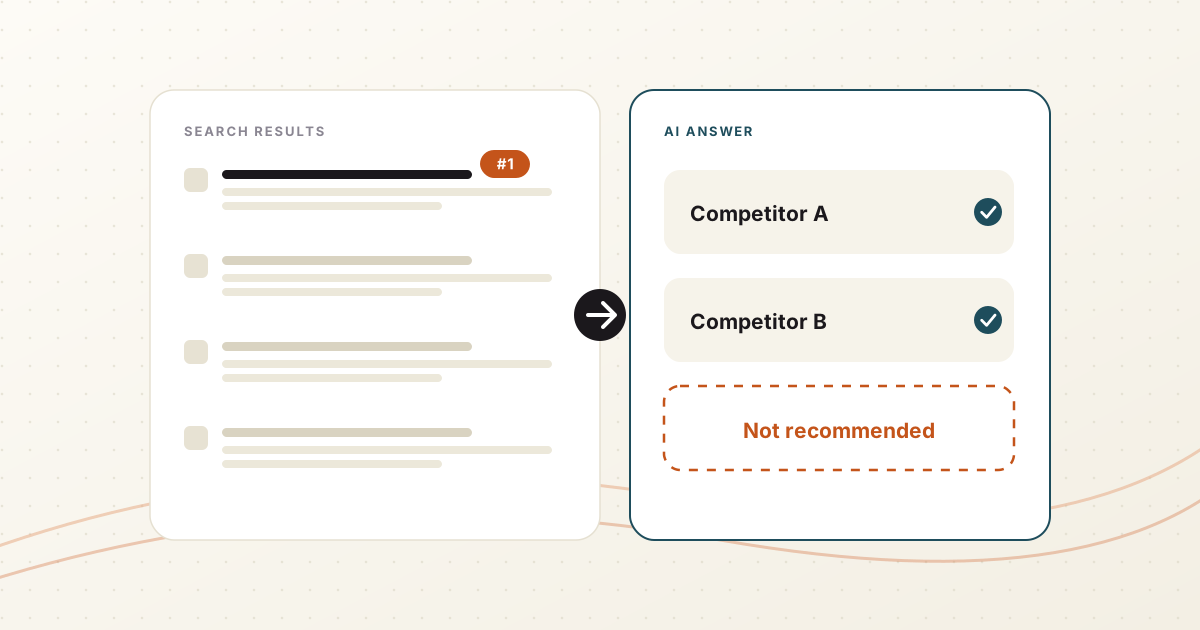
| ChatGPT recommends competitors, not you | Content structure: answer-first pages targeting category queries |
| ChatGPT describes your brand inaccurately | Entity definition: consistent brand description across all platforms |
| ChatGPT recommends you for the wrong buyer | Clarity: add segment, pricing, and use case specifics to key pages |
Step 4: Track share of mention monthly
Re-run your full prompt set every month. For each prompt, calculate your share of mention: the percentage of relevant AI responses that include your brand. Track this number over time. An improving share of mention across category prompts is the clearest signal that your programme is working.
The weekly high-leverage loop: pick 10 prompts, run a baseline, inspect sources, fix one page, close one citation gap, and recheck the following week. Consistency compounds faster than intensity.
Realistic timelines
ChatGPT visibility does not move overnight. Set expectations before committing budget:
| Timeframe | What to expect |
|---|---|
| Days 1 to 30 | Technical foundation in place; no visible mention increase yet |
| Days 30 to 60 | First branded query mentions begin appearing |
| Days 60 to 90 | Incremental category query appearances as citation density builds |
| Month 4 onwards | Consistent category visibility as authority compounds |
The most common reason programmes stall: brands focus on content production and ignore citation building. Publishing more pages on your own site without building third-party mentions produces diminishing returns. External mentions are what give ChatGPT confidence to recommend you. Your own content is what it cites once that confidence exists.
Ready to Build Your ChatGPT Visibility Programme?
Getting recommended by ChatGPT is not a single tactic. It is a programme combining entity infrastructure, citation building, content restructuring, and systematic measurement. Brands that earn consistent AI recommendations treat it as a discipline, not a one-time project.
Surgelify works with ecommerce and B2B brands to build and manage organic AI visibility programmes across ChatGPT, Perplexity, Gemini, and Copilot. Every engagement starts with a baseline assessment: a structured prompt audit that shows exactly where your brand stands today, which signals are missing, and what to fix first.
Book a strategy consultation with Surgelify to get your AI visibility baseline, a signal-by-signal gap analysis, and a programme structure that builds the citation density and entity authority your brand needs to earn consistent ChatGPT recommendations.