In this guide
Key takeaways
- Mention rate and citation rate measure different things. Mention rate is an easy-to-inflate awareness signal, citation rate a harder-to-earn consideration signal.
- Share of AI voice is the competitive metric, and prompt-level tracking is where measurement gets serious.
- Ask: "If we hit your targets in month three, what will have changed in our pipeline?"
- The guide closes with red flags and an evaluation checklist.
Most AI visibility agencies will hand you a report full of numbers. Fewer will hand you numbers that mean anything.
That gap matters enormously when you are standing in front of a CFO or CMO trying to justify a five-figure monthly retainer on something as intangible-sounding as "being mentioned by ChatGPT." The challenge is not finding an agency that tracks metrics. The challenge is finding one that tracks the right metrics, connects them to commercial outcomes, and can explain what good looks like before the engagement begins.
This guide gives marketing leaders a practical evaluation framework. Use it to interrogate any agency's measurement methodology before you sign, and to build the internal business case once you do.
The core question to ask any AI visibility agency: "If we hit your targets in month three, what will have changed in our pipeline?" If they cannot answer that cleanly, the reporting is decorative.
Mention Rate vs Citation Rate: Not the Same Thing
These two terms get used interchangeably by agencies that do not understand the distinction. They measure fundamentally different things, and conflating them is one of the most common ways sloppy reporting inflates apparent performance. HubSpot's AEO benchmarking guide puts it directly: "Use mention rate as a leading indicator and citation rate as your primary KPI."
Two metrics, two meanings
Mention rate
- Brand appears in any form in the response
- A passing reference, named example or included option
- Awareness signal, easy to inflate
Citation rate
- Brand cited as a source, recommendation or direct answer
- Shows how often AI actively directs users to you
- Consideration signal, harder to earn
Mention rate is the percentage of relevant AI-generated responses in which your brand appears in any form, whether as a passing reference, a named example, or an included option. It is a broad reach metric.
Citation rate is the percentage of responses in which your brand is cited as a source, a recommended option, or a direct answer to a commercial query. It is a precision metric. It tells you how often AI systems are actively directing users towards your brand, not simply acknowledging it exists.
| Metric | What it measures | Commercial relevance |
|---|---|---|
| Mention rate | Brand appears in response | Awareness signal; easy to inflate |
| Citation rate | Brand cited as answer or recommendation | Consideration signal; harder to earn |
The distinction matters because mention rate is easy to game and easy to misrepresent. An agency can inflate mention rate by tracking low-intent prompts where your brand is mentioned alongside dozens of others. Citation rate on high-intent, decision-stage prompts is the number that actually correlates with buyer consideration.
Ask any agency: "Do you report mention rate and citation rate separately? And what proportion of your tracked prompts are decision-stage queries rather than informational ones?"
Share of AI Voice: The Competitive Metric That Actually Matters
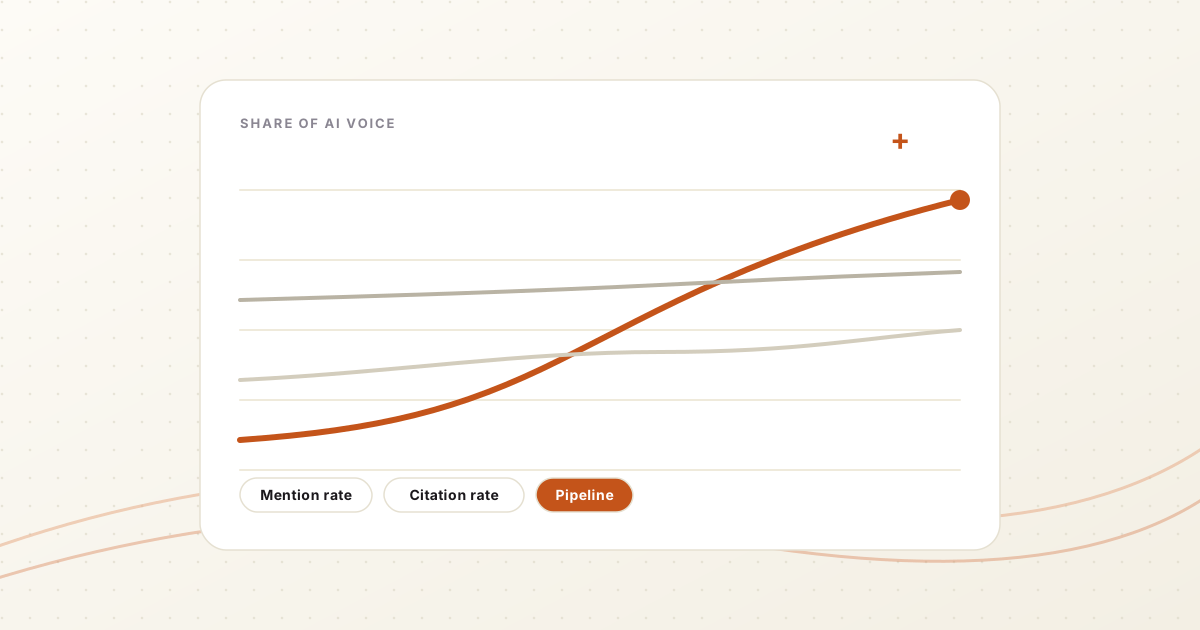
Absolute mention or citation numbers tell you very little in isolation. A 12% citation rate sounds reasonable until you learn that your primary competitor is sitting at 47% across the same prompt set. According to 2026 cross-industry benchmarks, the top quartile for agencies and consultancies sits at a composite score of 74, compared to a median of 51. That 23-point gap is entirely invisible if you are only tracking your own numbers. Share of AI voice reframes the conversation from "how visible are we?" to "how visible are we relative to who we are competing against?"
Share of AI voice is calculated by measuring how often your brand is cited across a defined set of tracked prompts, then expressing that as a proportion of all brand citations across the competitive set in those same prompts.
Why competitive context is non-negotiable
Buyers using AI tools to research a category are not evaluating your brand in isolation. They are receiving a shortlist. If an AI system consistently builds that shortlist from three or four brands, your commercial objective is to be on it more reliably than your competitors, not simply to appear occasionally.
A serious agency will:
-
Define your competitive set at the start of the engagement
-
Track share of AI voice across that competitive set, not just your brand in isolation
-
Report directional movement (gaining or losing ground) each period
-
Break down share by prompt intent category (awareness, comparison, decision)
An agency that only reports your own brand's numbers without competitive context is giving you a dashboard, not intelligence. Share of AI voice is the metric that tells a CFO whether the investment is working relative to the market, which is the framing that wins internal sign-off.
Ask any agency: "Can you show me a sample competitive share-of-voice report? Which competitors would you track, and how do you define the prompt set?"
Prompt-Level Tracking: Where Measurement Gets Serious
Aggregate metrics are useful for board slides. Prompt-level tracking is where you find out why performance is moving and what to do about it.
Prompt-level tracking means the agency maintains a structured library of specific queries, tests those queries regularly across one or more AI platforms, and records exactly what each AI system returns. Not a summary. The actual response, including which brands appear, in what position, with what framing, and sourced from which pages.
What a proper prompt library looks like
A well-constructed prompt library is not a random collection of keyword variations. It is a deliberate map of your buyer's decision journey, organised by intent stage:
-
Awareness prompts: "What are the best [category] tools for [use case]?" These establish whether your brand is recognised in the category.
-
Comparison prompts: "How does [your brand] compare to [competitor]?" These test whether AI systems have accurate, favourable information about your positioning.
-
Decision prompts: "Which [category] provider should I use for [specific need]?" These are the highest-value queries, the ones where a citation directly influences a purchasing conversation.
Agencies that track 10 to 20 generic prompts and call it comprehensive are not doing the work. A serious engagement typically involves 50 to 150 tracked prompts, refreshed regularly as buyer language evolves, with clear tagging by intent stage and competitive set.
Prompt-level data also enables diagnosis. If citation rate drops in a particular intent category, a good agency can trace it to a specific content gap, a competitor gaining authority on a particular topic, or a change in how an AI platform weights sources. Without prompt-level granularity, you are left with a number that moved and no explanation for why.
Ask any agency: "How many prompts are in your tracking library? How are they categorised by intent? How often do you refresh them, and can we see the actual AI responses, not just the aggregated scores?"
Pipeline Attribution: Connecting AI Visibility to Revenue
This is where most agencies fall short, and where most marketing leaders face the hardest internal scrutiny.
AI visibility metrics exist on a spectrum from leading indicators (mention rate, citation rate, share of voice) to lagging commercial outcomes (qualified traffic, pipeline, revenue). A credible agency understands where each metric sits on that spectrum and is honest about what can and cannot be directly attributed.
What attribution actually looks like in practice
Clean pipeline attribution for AI visibility typically involves three layers:
-
AI-referred traffic tracking: Identifying sessions that arrive via AI platforms (ChatGPT, Perplexity, Gemini, Copilot) through UTM parameters, referrer data, and GA4 source segmentation. This establishes the volume of users arriving from AI-assisted discovery.
-
Behavioural quality signals: Measuring whether AI-referred visitors exhibit higher commercial intent than average traffic: lower bounce rates, deeper page engagement, higher conversion to enquiry or trial. This is the evidence that AI visibility is attracting qualified buyers, not just any visitors.
-
CRM correlation: Matching AI-referred traffic periods against pipeline creation and close rates. This is imprecise but directionally valid: if citation rate increases in Q2 and AI-referred pipeline grows in Q3, that is a commercially meaningful signal even without perfect attribution.
No agency can offer a clean, deterministic attribution model for AI visibility because the buyer journey is non-linear and AI-assisted research often happens before any trackable session begins. An agency that claims otherwise is overstating its capability. What a credible agency can do is build a multi-signal picture that gives a CFO enough confidence to continue investment.
Ask any agency: "How do you track AI-referred traffic in our analytics? What CRM or pipeline signals do you use to validate that AI visibility is driving commercial outcomes, not just impressions?"
What Good Benchmarks Actually Look Like
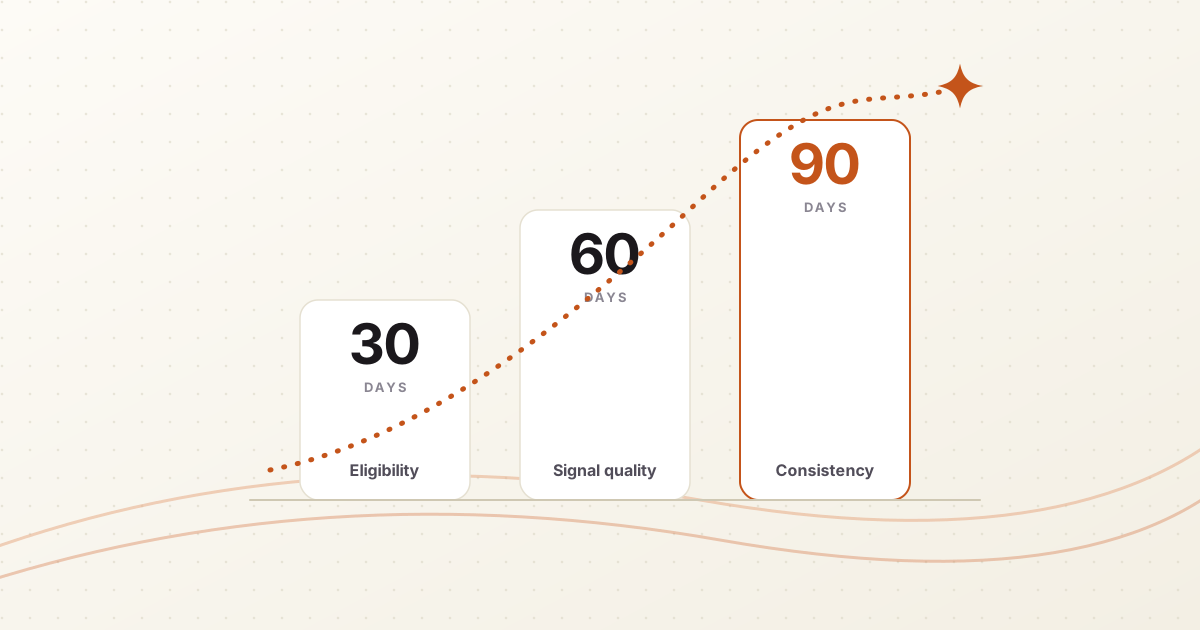
One of the most revealing questions you can ask an agency is: "What should we expect in the first 90 days?" A vague answer ("it depends on your industry") is not a benchmark. It is a way of avoiding accountability.
Good benchmarks are specific, contextualised, and honest about variance. They should be set before work begins, not adjusted retrospectively. Aggregate tracking data from MaxAEO across hundreds of brands shows that the median non-branded mention rate sits at roughly 31%, with the top quartile clearing 58% and the bottom quartile falling below 12%. The right benchmark is not the blended average; it is your industry's top quartile on your buyers' primary AI platform.
Realistic expectations by stage
| Timeframe | What to expect | Red flag if... |
|---|---|---|
| 0–30 days | Baseline audit complete, prompt library defined, competitive share of voice established | No baseline exists; agency is already claiming improvements |
| 30–90 days | First citation rate movements on lower-competition prompts; content gaps identified and addressed | Agency promises significant citation gains before content changes have been indexed |
| 90–180 days | Measurable share-of-voice movement on mid-competition prompts; AI-referred traffic visible in analytics | No traffic signal whatsoever; all metrics are internal tracking only |
| 6–12 months | Competitive parity or advantage on high-intent prompts; pipeline attribution signal established | Agency cannot connect any metric to a commercial outcome after six months |
The benchmark conversation is a credibility test. An agency that sets vague targets is protecting itself from accountability. An agency that sets aggressive targets without caveats is telling you what you want to hear. The right answer includes a range, explains the variables that affect it, and distinguishes between what the agency controls (content, strategy, execution) and what it does not (how individual AI platforms weight sources, how competitors respond).
Ask any agency: "What benchmarks are you willing to commit to in writing for months one, three, and six? What variables could cause those benchmarks to shift, and how would you communicate that?"
Red Flags in Agency Reporting
Knowing what good looks like is half the evaluation. The other half is recognising when a report is designed to impress rather than inform.
Seven warning signs to look for
1. No baseline, no context. If an agency's first report shows you numbers without establishing what those numbers were before they started work, you have no way to measure progress. Any improvement claim is unverifiable.
2. Mention rate as the headline metric. Agencies that lead with mention rate are prioritising the easiest number to inflate. If citation rate on decision-stage prompts is buried or absent, ask why.
3. No competitive data. A report that only shows your brand's performance without competitive share-of-voice context is incomplete by design. You cannot evaluate performance without knowing what your competitors are achieving on the same prompts.
4. Proprietary scoring systems with no methodology. Some agencies create composite "AI visibility scores" that blend multiple signals into a single number. That is not inherently wrong, but if the methodology is opaque or the weighting is not disclosed, the score cannot be independently validated. Ask for the underlying data.
5. No AI-referred traffic data. If an agency claims to be improving your AI visibility but cannot point to any signal in your own analytics, something is missing. Organic AI-referred sessions are measurable. Their absence from reporting is a significant gap.
6. Retrospective benchmark adjustments. If targets shift after the fact without a clear explanation tied to external factors (a platform algorithm change, a major competitive move), the agency is managing its own accountability rather than yours.
7. No explanation for negative movements. Metrics go down as well as up. An agency that only reports positive news or attributes every decline to factors outside its control is not giving you an honest picture of performance.
The underlying principle: good reporting should make you more capable of making decisions, not more dependent on the agency's interpretation of opaque data. If you cannot understand the report without the agency explaining it to you every month, the report is not fit for purpose.
The Evaluation Checklist: Questions to Ask Before You Sign
Pull this into your agency evaluation process. These questions are designed to surface measurement maturity quickly, whether you are in a first meeting or reviewing a proposal.
| Evaluation area | Question to ask | What a strong answer looks like |
|---|---|---|
| Metric clarity | Do you separate mention rate from citation rate? | Yes, with clear definitions and separate reporting lines |
| Competitive context | How do you measure share of AI voice? | Defined competitive set, tracked prompts, directional movement each period |
| Prompt methodology | How many prompts do you track, and how are they categorised? | 50+ prompts, tagged by intent stage, refreshed regularly |
| Pipeline connection | How do you connect AI visibility to commercial outcomes? | AI-referred traffic in GA4, behavioural quality signals, CRM correlation |
| Benchmarks | What should we expect in months one, three, and six? | Specific ranges with stated variables and caveats |
| Reporting transparency | Can we see the actual AI responses, not just scores? | Yes, with raw response data available on request |
| Accountability | How do you handle periods where metrics decline? | Proactive explanation, root cause analysis, strategy adjustment |
No agency will have a perfect answer to every question. But the quality of how they respond tells you as much as the content of what they say. Vague answers, deflection, or over-confidence on metrics they cannot control are the real signals.
The Standard Worth Holding Agencies To
AI visibility is a legitimate and increasingly important commercial discipline. The measurement infrastructure around it is maturing fast, which means the gap between agencies that have built rigorous reporting and those that have not is widening. One data point worth keeping in mind: research published in 2026 found that the overlap between top-10 Google rankings and AI-answer citations has collapsed from roughly 75% in mid-2025 to just 17–38% by early 2026. Traditional SEO rankings and AI visibility are now largely separate disciplines, which makes measurement methodology more important, not less.
The standard worth holding any agency to is straightforward: they should be able to show you, at any point in the engagement, exactly where your brand sits in the AI consideration set for your most commercially important buyer queries, how that position has changed since they started work, how it compares to your key competitors, and what the evidence suggests about commercial impact.
If that picture is not available, the reporting is not finished.
Surgelify works with marketing leaders who need AI visibility measurement that holds up to internal scrutiny. Our engagements are built around prompt-level tracking, competitive share-of-voice reporting, and pipeline attribution frameworks designed to give you the evidence base to justify continued investment.
Book a strategy consultation to see how we approach measurement, what our reporting looks like in practice, and what benchmarks are realistic for your category.