In this guide
Key takeaways
- ChatGPT Ads have no firmographic layer: no job title, company size, industry or account-list targeting, no ABM upload and no retargeting.
- Targeting is built on the context of the conversation happening in real time.
- The guide walks through set-up step by step, a workaround for the targeting problem and the metrics that matter.
- Paid alone is not enough: the organic AI visibility layer has to run alongside it.
Your B2B SaaS buyers are using ChatGPT to research software, compare vendors, and shortlist solutions before they ever visit your website. OpenAI began serving ads inside those conversations in February 2026. The self-serve platform opened to all businesses in May 2026. For the first time, you can place your product in front of someone mid-research, at the exact moment they are forming an opinion about which tools deserve a closer look.
Most advice circulating about ChatGPT Ads treats the platform like a lighter version of Google Ads or LinkedIn Campaigns. That framing will cost you budget and produce disappointing results.
The critical difference: ChatGPT Ads do not let you target by job title, company size, industry, or account list. There is no firmographic layer. No ABM upload. No retargeting. Targeting is built entirely on the context of the conversation happening in real time. Your strategy has to be built around conversational intent, not audience segments.
This guide explains how to launch ChatGPT Ads correctly for a B2B SaaS product: what the platform actually does, how to structure your first campaign, where the genuine opportunities are, and why organic AI visibility must run alongside paid to make the channel work at all.
What ChatGPT Ads Actually Are (And What They Are Not)
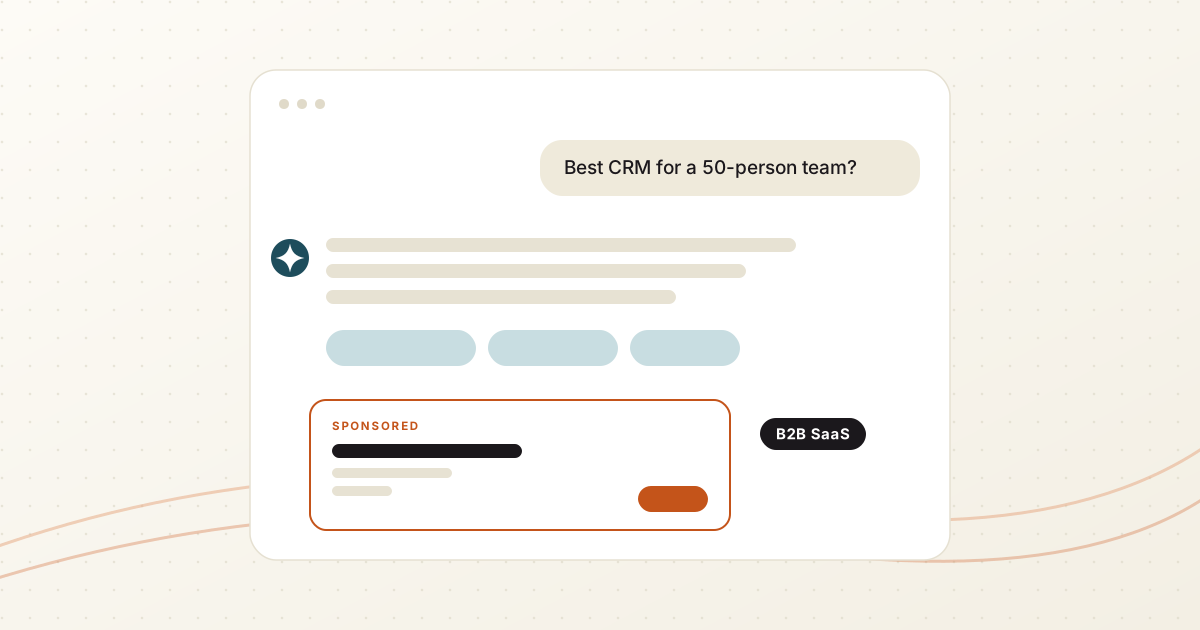
ChatGPT Ads are sponsored placements that appear below a ChatGPT response when the conversation matches an advertiser's targeting context. OpenAI labels them clearly as sponsored and separates them visually from the AI's answer. The ad never appears inside the response itself, and the model's organic answer is not shaped by who is advertising.
Each ad unit carries an advertiser name, favicon, headline, description, image, and a landing page URL. Think of it as a contextually triggered card. Not a search result. Not a chatbot response.
The tier problem every B2B team needs to understand
Ads appear exclusively to users on the Free and Go tiers. Plus, Pro, Business, Enterprise, and Education accounts are entirely ad-free. For B2B SaaS, this is the single most commercially important fact about the platform.
The implication is direct. Your most senior, highest-intent buyers are on paid professional plans. They will never see your ChatGPT ad. The audience you are reaching skews toward earlier-stage researchers, individual contributors, and users who have not yet committed to a paid plan.
This does not make the channel worthless. It changes who you are reaching and what message is appropriate. Product-led SaaS with a free trial or freemium entry point is better positioned here than high-ACV enterprise software that relies on multi-stakeholder approval.
What the platform can and cannot do
| Capability | Available now |
|---|---|
| Contextual targeting via conversation topic | Yes |
| CPC and CPM bidding | Yes |
| Conversion tracking (pixel and Conversions API) | Yes |
| Geographic targeting and exclusions | Yes |
| Custom audiences (hashed email/phone upload) | Yes, requires 25,000+ matched users |
| Job title or seniority targeting | No |
| Company or account-based targeting | No |
| Retargeting website visitors | No |
| CRM list matching below 25,000 users | No |
The absence of firmographic targeting is not a gap OpenAI intends to fill. OpenAI has stated it is deliberately building guardrails against narrow demographic targeting. Build your strategy around what the platform does today, not what you hope it will offer next quarter.
Is ChatGPT Ads Right for Your B2B SaaS Product?
Before building a campaign, answer one question honestly: can your product convert a user who finds you through a contextual ad, with no prior brand awareness?
The channel rewards certain SaaS business models far more than others.
Products that are well positioned
-
Product-led SaaS with a free trial or freemium tier. The friction from ad to first value is low. A user researching project management tools, note-taking apps, or workflow automation can sign up and experience the product within minutes of clicking your ad.
-
Low-to-mid ACV software with a single decision-maker. If one person can evaluate and purchase without a procurement process, the channel can drive direct conversions.
-
Tools solving problems people actively research in ChatGPT. If your product category maps closely to questions buyers ask conversationally ("what's the best CRM for a small sales team?"), your contextual relevance will be high.
Products that face structural disadvantages
-
High-ACV enterprise software. Your buyers are on paid ChatGPT plans and will not see your ads. The decision cycle involves multiple stakeholders and cannot be compressed into a single ad interaction.
-
Retargeting-dependent brands. If your current paid strategy relies heavily on warming up cold audiences through repeated exposure, that capability does not exist here yet.
-
Highly regulated categories. OpenAI's ad policies restrict finance, health, and legal advertising on a case-by-case basis. Fintech, healthtech, and legaltech SaaS should verify eligibility before investing in campaign setup.
The honest assessment: for most enterprise B2B SaaS, ChatGPT Ads should be a small-budget experiment, not a primary acquisition channel. The higher-return activity for reaching senior buyers inside ChatGPT is earning organic citations inside the model's answers, which requires a different strategy entirely. More on that in the final section.
How to Set Up Your First ChatGPT Ads Campaign: Step by Step
The OpenAI Ads Manager is the self-serve portal where all campaigns are built and managed. Since May 2026, there is no minimum spend requirement, so you can begin with a test budget that matches your appetite for experimentation. The platform is available in more than 40 countries, including the UK, US, Canada, Australia, and across most of Europe.
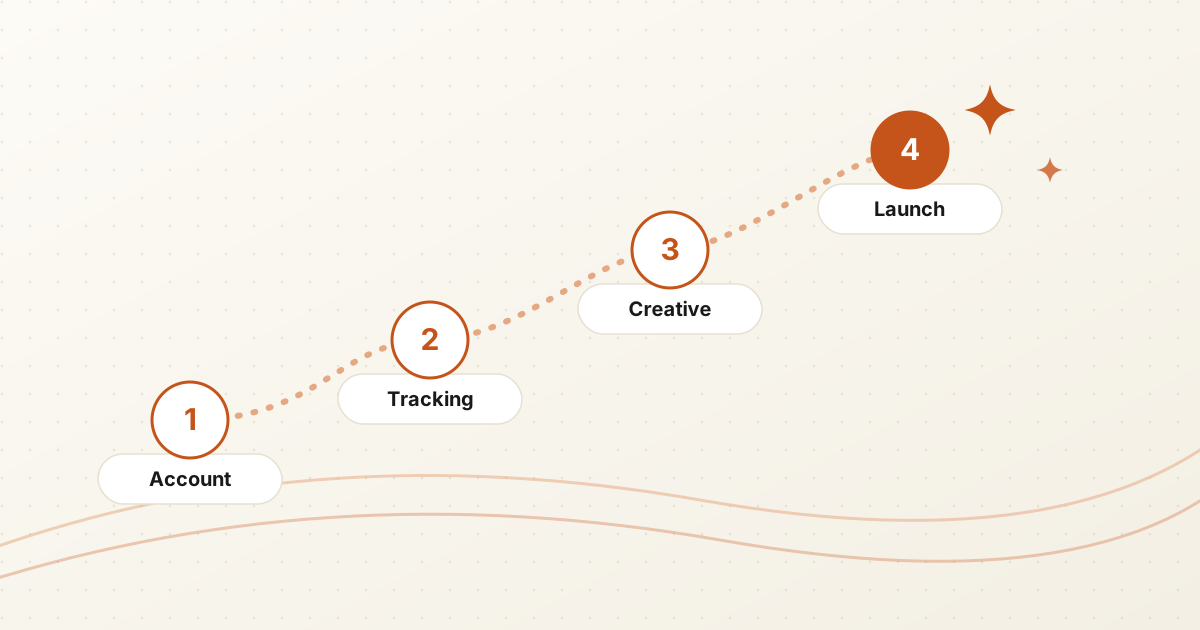
Step 1: Create your advertiser account
Go to ads.openai.com and create an account using your business details. You will need to provide payment information and agree to OpenAI's advertising policies. Review the restricted categories before proceeding: political, adult, gambling, alcohol, tobacco, and crypto content is prohibited. Finance, health, and legal categories face additional review.
Step 2: Install conversion tracking before you spend anything
This is the step most advertisers skip and later regret. OpenAI supports pixel-based tracking and a Conversions API. Install one before your campaign goes live. You need clean data from day one.
Decide what you are measuring:
-
Free trial sign-ups
-
Demo bookings
-
Lead form completions
-
Paid plan conversions
Without conversion tracking, you have no way to judge whether the channel is generating any commercial return.
Step 3: Choose your campaign objective
ChatGPT Ads Manager supports three objectives:
| Objective | Bidding model | Best use case |
|---|---|---|
| Reach | CPM | Brand awareness, early-stage market education |
| Clicks | CPC | Driving traffic to a trial or landing page |
| Conversions | Conversion bidding | Optimising directly for sign-ups or leads |
For most B2B SaaS first campaigns, Clicks is the right starting point. It gives you measurable cost-per-click data and lets you assess whether the traffic is converting before committing to conversion-based bidding.
OpenAI recommends a starting maximum bid of $3 to $5 per click for Clicks campaigns. B2B categories have been reporting CPCs in the $8 to $15 range in early data, which reflects the higher commercial intent of the conversations being matched.
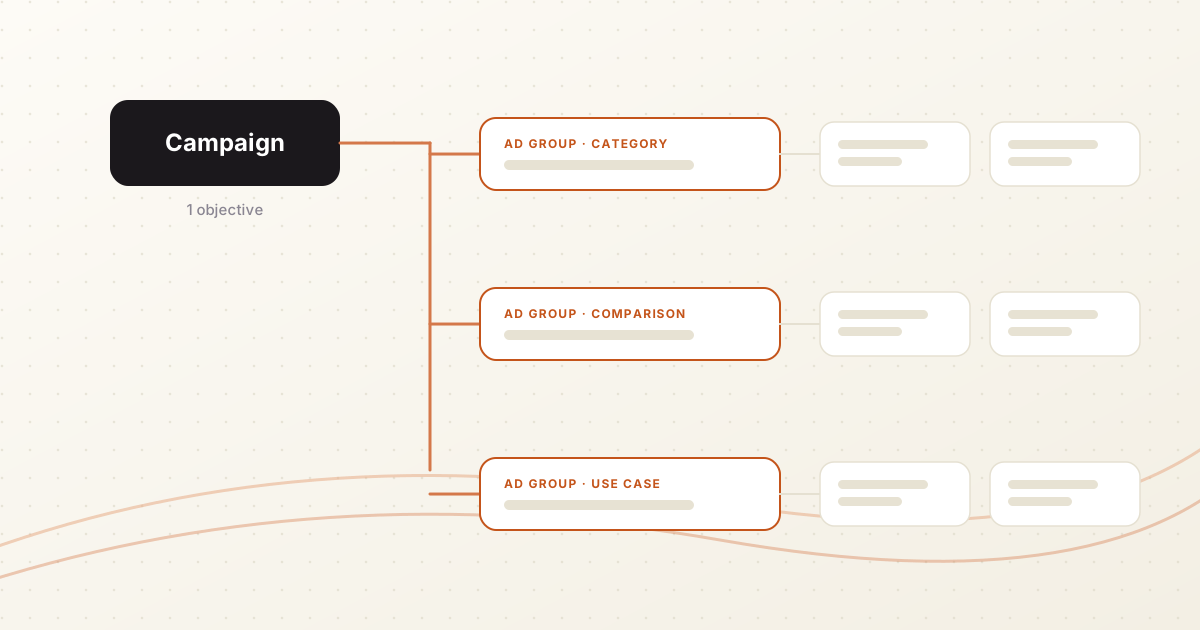
Step 4: Build your ad groups with context hints
This is where ChatGPT Ads departs most significantly from every other paid channel you have used. There are no keywords in the traditional sense. Instead, you write context hints: plain-language descriptions of the conversations, topics, and situations where your product is relevant.
A useful formula for B2B SaaS:
[Audience] + [task or problem] + [situation or constraint] + [relevant product capability]
Example context hint for a project management tool: "Teams evaluating project management software, comparing tools for remote collaboration, managing multiple client projects, looking for alternatives to spreadsheets for task tracking"
What makes context hints effective:
-
Describe the conversation, not the audience demographic
-
Include the problem being solved, not just the product category
-
Use language that mirrors how buyers phrase their research questions
-
Add negative context to exclude irrelevant conversations (for example, exclude "student" or "personal use" if you only serve businesses)
Write three to five distinct ad groups, each targeting a different conversational context. A user asking "what is the best CRM for a startup sales team" is in a very different conversation from one asking "how do I migrate from Salesforce to a lighter CRM". Both might be your buyer. The message that lands will be different.
Step 5: Create your ad creative
Each in-conversation ad unit includes:
-
Headline: up to 30 characters
-
Description: up to 90 characters
-
Image: displayed alongside the unit
-
Landing page URL
-
Advertiser name and favicon
The format is compact. The constraint is actually useful: it forces clarity. A headline that works in this environment is one that completes the thought the user is already having, not one that interrupts it with a generic brand claim.
Weak headline: "Try [Product] Free Today" Stronger headline: "Manage client projects without the chaos"
The description should extend the headline, not repeat it. Use it to name the specific outcome or capability that is most relevant to the conversational context you are targeting in that ad group.
Step 6: Set your budget, geography, and schedule
-
Set a daily budget you are comfortable running for at least two to three weeks before drawing conclusions. The auction is still maturing, and early data can be volatile.
-
Use geographic targeting to focus on markets where your product is available and where your sales team can follow up.
-
Schedule your campaign to run continuously rather than in short bursts. Contextual matching improves as the system gathers performance data on your ads.
Step 7: Submit for review and launch
All campaigns require OpenAI review before serving. Review typically takes one to two business days. Once approved, your ads begin serving to eligible conversations automatically. Monitor performance through the Ads Manager dashboard, which reports on impressions, clicks, and (if tracking is installed) conversions. Reporting is aggregated: you will not see individual conversations or user data.
The B2B SaaS Targeting Problem and How to Work Around It
The absence of firmographic targeting is the central strategic challenge for B2B SaaS on ChatGPT Ads. On LinkedIn, you can target by job title, seniority, company size, and industry. On Google, you can layer in-market audiences and customer match. On ChatGPT, none of that exists.
What you can and cannot target
Firmographic targeting
- Job title
- Company size
- Industry
- Account lists, ABM upload and retargeting
Conversation context
- Targeting built on the context of the conversation
- Reaches buyers while they research and compare
- Shaped by buyer prompts and creative relevance
What you have instead is the context of the conversation itself. That is both the limitation and the opportunity.
Why conversational context is more valuable than it sounds
When someone asks ChatGPT "what project management tools work best for a distributed engineering team", they have already self-qualified. They have described their team structure, use case, and decision stage, all within a single prompt. No demographic targeting layer produces that level of specificity.
The strategic implication is direct. Write context hints that capture the language of high-intent conversations, not the language of your marketing copy. Think about what your best customers were researching in the weeks before they bought. Those are the conversations worth intercepting.
Using custom audiences where volume permits
OpenAI has introduced custom audience functionality that allows advertisers to upload hashed email or phone number lists for inclusion or exclusion targeting. The minimum matched audience size is 25,000 users.
For most B2B SaaS companies, this threshold is relevant primarily for exclusion: suppressing current customers from seeing your acquisition ads. If your email list is large enough, you can also use it to focus spend on known prospects who have engaged with your brand but not converted.
Practical note: do not build your strategy around custom audiences if your list is below the threshold. Use contextual targeting as your primary mechanism and treat audience tools as a refinement layer once you have volume.
Negative context: the underused lever
Most advertisers focus on what conversations to target and ignore what conversations to exclude. Negative context hints allow you to filter out irrelevant matches, which improves both relevance and cost efficiency.
Examples of negative contexts for B2B SaaS:
-
"personal use", "student", "hobby", "free tools only"
-
Competitor brand names if your product is not a direct migration path
-
Consumer categories adjacent to your market (for example, a business invoicing tool should exclude "personal finance" and "freelancer side project" conversations)
Negative context is the equivalent of negative keywords in Google Ads. Use it from day one rather than waiting for wasted spend to reveal the problem.
Measuring What Actually Matters
ChatGPT Ads reporting is aggregated by design. You see campaign-level impressions, clicks, and conversions. You do not see the individual conversations your ads appeared in, which users clicked, or any personally identifiable data.
This creates a measurement problem many advertisers do not anticipate. The temptation is to optimise for click volume. The right measure is post-click commercial outcome.
The metrics that matter for B2B SaaS
| Metric | What it tells you |
|---|---|
| Click-through rate (CTR) | Whether your creative and context hints are matching relevant conversations |
| Cost per click (CPC) | How competitive your category is in the auction |
| Landing page conversion rate | Whether the traffic has commercial intent and your page converts it |
| Cost per trial / cost per lead | The actual acquisition cost for a meaningful commercial action |
| Trial-to-paid conversion (tracked separately) | Whether ChatGPT Ad users have the same quality as other channels |
The most important comparison: measure your ChatGPT Ads cost per qualified lead against your LinkedIn and Google benchmarks. If the channel is delivering comparable quality at lower cost, scale it. If the cost per qualified lead is materially higher, the contextual targeting is not matching the right conversations and your context hints need revision.
What to do in the first 30 days
The auction is still young and performance data can be volatile in the early weeks. Treat the first month as a learning phase rather than a performance phase.
-
Run at least three ad groups with distinct context hints simultaneously to identify which conversational contexts produce the best click quality.
-
Review landing page heatmaps and session recordings to understand how ChatGPT Ad traffic behaves compared to other channels.
-
Do not pause campaigns within the first two weeks based on early CPC data alone. Allow the relevance-weighted auction to optimise.
-
After 30 days, cut the lowest-performing ad group, double down on the best, and introduce one new context hypothesis.
Why Paid Alone Is Not Enough: The Organic AI Visibility Layer
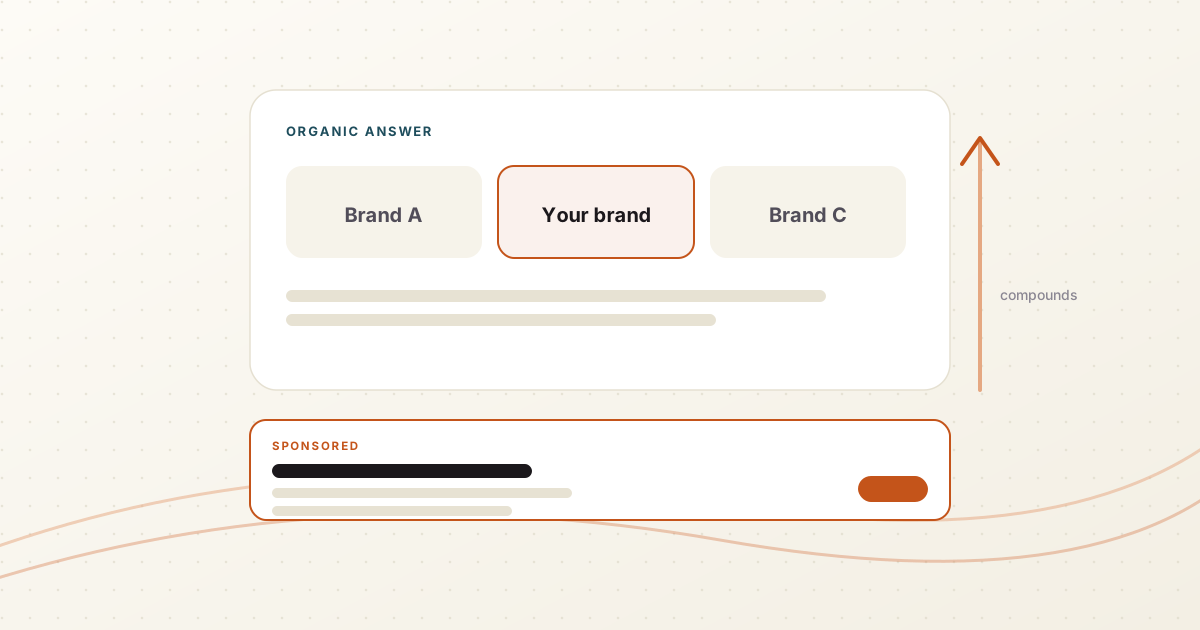
Most ChatGPT Ads guides do not address this: the ad appears below ChatGPT's answer. The answer itself is where the real commercial influence happens.
When a buyer asks ChatGPT "what are the best project management tools for engineering teams" and your product is not in the organic response, your ad appears in a weakened position. The user has already received a recommendation that did not include you. The ad is now working against the model's own authority. That is a harder conversion problem than it looks.
The brands that perform best on ChatGPT Ads are the ones ChatGPT already knows and trusts. Organic AI visibility, ensuring your product is accurately understood, cited, and recommended by AI systems, is not a separate discipline from your paid strategy. It is the foundation that makes paid activity more credible and more effective.
What organic AI visibility means in practice
AI systems like ChatGPT construct answers from sources they have been trained on and, increasingly, from sources retrieved in real time. For your product to appear in those answers, it needs to exist clearly and credibly in the places AI systems look: authoritative publications, structured data on your own site, third-party reviews, industry directories, and content that accurately describes what your product does, who it serves, and what outcomes it produces.
This overlaps with traditional SEO but is not the same thing. The questions to answer are:
-
Can an AI system accurately describe your product category, use case, and differentiation?
-
Does your product appear in conversations about your category on authoritative platforms?
-
Is your website structured so AI systems can extract and cite specific claims?
-
Are there credible third-party sources that corroborate what you say about your product?
Paid and organic as one system
The correct framing is not "should we do ChatGPT Ads or AI visibility work?" Both activities serve the same commercial goal: being present when a buyer is forming an opinion about which products deserve consideration.
Organic visibility gets your product into the answer. Paid placement gives you a guaranteed presence below it. Together, they create a situation where a buyer researching your category encounters your brand twice in the same conversation, once in the model's recommendation and once in the sponsored unit beneath it. That dual presence is meaningfully more powerful than either in isolation.
The brands that will dominate AI-assisted discovery are not the ones that arrive first on the ads platform. They are the ones that build the authority required to be recommended organically, then use paid placement to reinforce that presence at the moment of decision.
What to Do Next
ChatGPT Ads is a live channel with a self-serve platform, no minimum spend, and a growing audience of users who are actively researching products and services in real time. For B2B SaaS, the opportunity is real but the execution requirements are different from any paid channel you have managed before.
The practical starting point:
-
Assess your fit. Does your product have a short enough sales motion to convert from a contextual ad? Is your buyer likely to be on the Free or Go tier?
-
Build your organic AI visibility baseline first. Understand whether your product is currently being cited or recommended in relevant ChatGPT conversations before you invest in paid placement.
-
Launch a structured test. Set up conversion tracking, write three to five context-hint-based ad groups, run for 30 days, and measure cost per qualified lead against your existing channels.
-
Treat the two disciplines as one system. Paid placement and organic AI visibility are not competing priorities. They are complementary mechanisms for the same commercial goal.
Surgelify specialises in both: managed ChatGPT Ads campaigns built around conversational strategy, and AI visibility programmes that ensure your product is accurately understood and recommended by AI systems before a buyer ever sees your ad. If you want a clear picture of where your product currently stands in AI-assisted discovery, and what a combined paid and organic strategy would look like for your category, book a strategy call with the Surgelify team.