In this guide
Key takeaways
- ChatGPT is a conversational channel, not a search channel. Start from where in the buyer's research journey ChatGPT already plays a role.
- The playbook covers campaign structure, targeting and creative for considered purchases, landing pages and pipeline measurement.
- Paid placements and organic citation building are two separate systems that should be managed separately and run together.
Most B2B SaaS marketing leaders approaching ChatGPT Ads are thinking about it the wrong way. They are asking "how do we get our ads into ChatGPT?" when the more useful question is "where in our buyer's research journey does ChatGPT already play a role, and what do we want to happen when it does?"
That distinction matters because ChatGPT advertising is not a search channel. It is a conversational channel. Buyers are not typing short queries and scanning results. They are describing problems, asking follow-up questions, comparing options, and working through purchasing decisions in real time. The commercial opportunity is significant, but only for teams willing to build campaigns around that behaviour rather than simply repurposing paid search logic.
The channel went live in February 2026. OpenAI launched ChatGPT advertising on 9 February 2026 and opened self-serve access via Ads Manager at ads.openai.com to all US businesses on 5 May 2026. Ads reach Free and Go tier users across the US, UK, Canada, Australia, and New Zealand, with more markets being added. There is no minimum spend requirement, which makes structured pilots genuinely accessible.
This guide covers what B2B SaaS teams need to know to build campaigns that actually work: structure, objectives, targeting, creative, landing pages, measurement, and the relationship between paid placement and organic AI visibility.
How ChatGPT Ads Actually Work
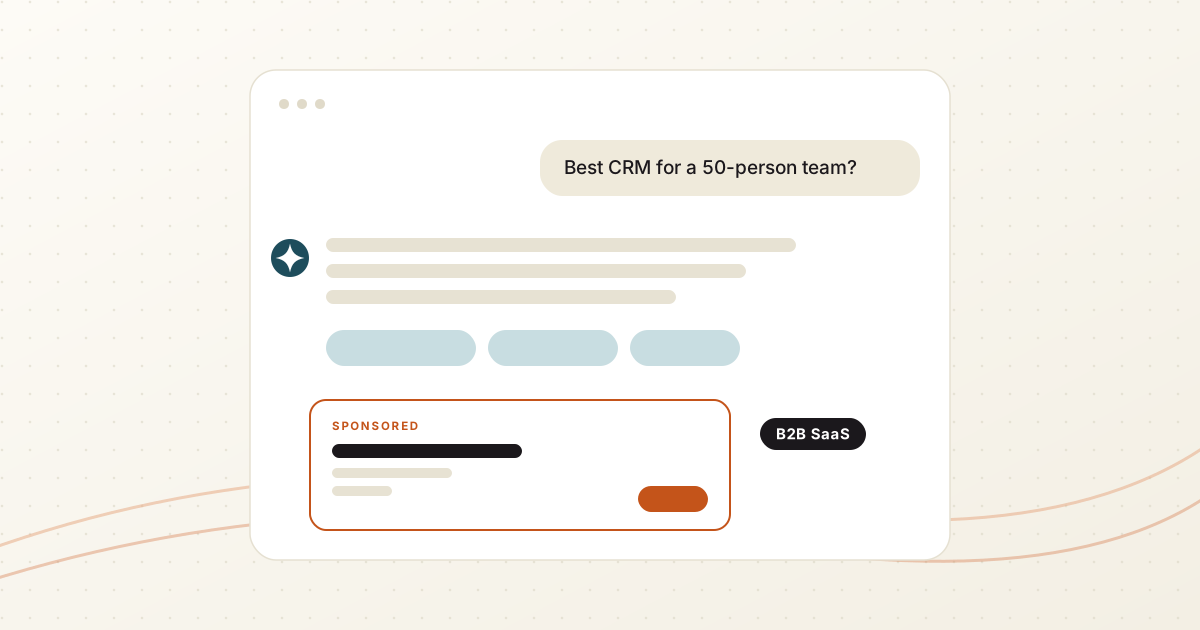
Before building a campaign, it is worth being precise about the mechanics. Sponsored units appear as clearly labelled placements below ChatGPT's response, visually separated from the organic answer. OpenAI is explicit that ads do not influence what ChatGPT tells users. They appear after the answer, not inside it.
Matching works through conversational context, not keyword bids. The platform uses the topic of the current conversation, the user's broader chat history, and their past interactions with ads to determine relevance. There is no cookie-based targeting, no PII, no ABM account lists, no job-title targeting, and no retargeting available in the current platform.
Key implication for B2B SaaS: Targeting precision comes from the quality of your conversational context signals, not from audience segments you upload. The offer and creative do a significant amount of the filtering work.
What the campaign structure looks like
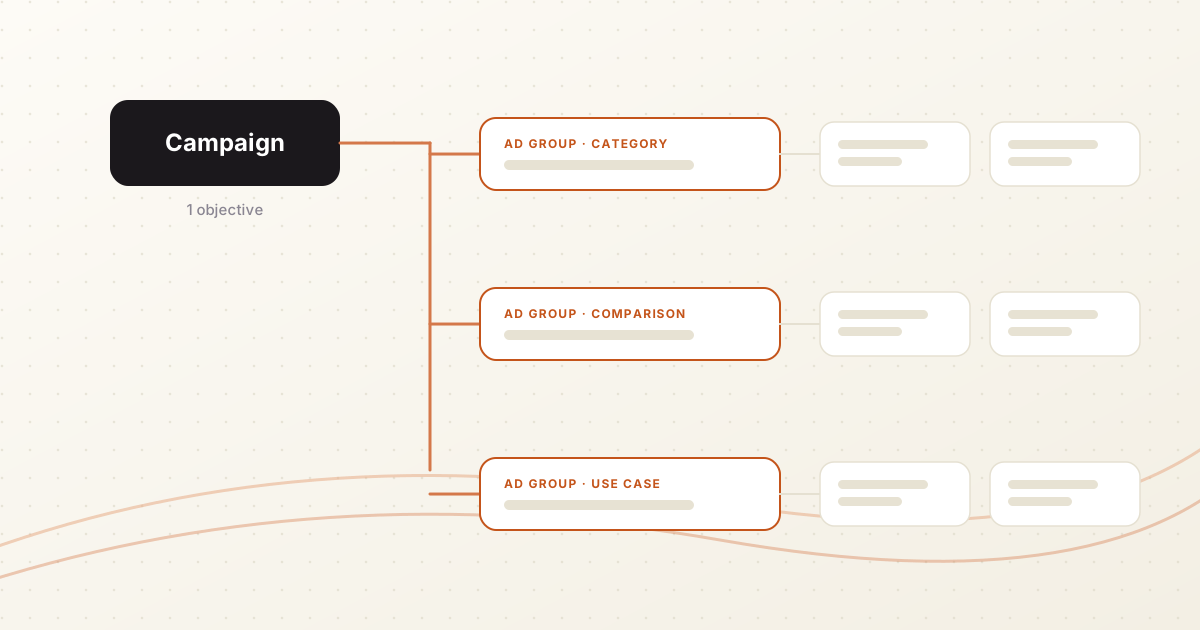
OpenAI's Ads Manager uses a three-level hierarchy:
-
Campaign: Defines the objective, budget, start and end dates, and target countries.
-
Ad group: Organises ads around a shared intent theme, using context hints to guide matching. Context hints are descriptions of the conversations or topics where your product is relevant. They are directional, not exact-match.
-
Ad: The creative unit shown in ChatGPT, comprising brand name, logo, title, copy, image, and landing page URL.
CPC bidding starts at roughly £3 to £5 per click. CPM options are also available. A meaningful B2B pilot typically starts at £4,000 to £8,000 per month to generate enough data for decisions.
Campaign Structure for B2B SaaS
The most common structural mistake is building one broad campaign with a generic "SaaS" context theme. That approach produces low-quality traffic because it fails to match the specific conversation happening when the ad appears.
Effective B2B SaaS campaigns are structured around buyer intent themes, not product categories. Each campaign should correspond to a distinct stage or type of research conversation.
| Campaign | Intent theme | Context hint focus | Landing page |
|---|---|---|---|
| Category demand | Core problem | User solving the primary operational problem | Solution page |
| Comparison | Alternatives | User comparing category leaders or switching tools | Comparison page |
| Use cases | Specific workflow | User needs a particular outcome or integration | Use-case page |
| Implementation | Migration or setup | User concerned about timeline or data transfer | Implementation guide |
| Industry fit | Vertical constraints | User has sector-specific requirements | Industry page |
Separating campaigns by objective
Within this structure, campaigns should be further separated by conversion objective. Combining lead generation, demo booking, and trial sign-up goals inside a single campaign produces measurement noise that makes optimisation impossible.
-
Lead generation campaigns suit early-stage buyers who are building a category understanding. The offer is typically a guide, benchmark report, or assessment. Optimise for content engagement, then track downstream progression.
-
Demo request campaigns work for buyers who are actively evaluating providers. The prompt context will involve comparisons, pricing questions, or capability assessments. The offer is a structured product demonstration with a clear agenda.
-
Trial or freemium campaigns suit products with a self-serve motion where buyers can validate value independently. The offer is direct access, not a gated conversation.
The rule: match the campaign objective to the buyer's decision stage, not to what your sales team finds easiest to process.
Buyer Prompt Targeting and Creative for Considered Purchases
B2B SaaS buyers using ChatGPT are not asking simple questions. They are having extended research conversations. Understanding the types of prompts that indicate commercial intent is the foundation of effective context hint writing.
High-value prompt categories for B2B SaaS
Rather than targeting broad software categories, structure context hints around the specific problem and decision conversations your buyers have:
-
Category comparison prompts: "What is the best [category] software for a [team size] company?" or "How does [approach A] compare to [approach B]?"
-
Competitor alternative prompts: "What are the alternatives to [named incumbent]?" or "I am looking to switch from [tool], what should I consider?"
-
Integration and compatibility prompts: "Does [category tool] integrate with [named platform]?" or "What CRM integrations does [category] software typically offer?"
-
Implementation and migration prompts: "How long does it take to implement [category software]?" or "What are the risks of migrating from [legacy system]?"
-
Pricing and total cost prompts: "What should I expect to pay for [category] software at [company size]?" or "What is the total cost of ownership for [category]?"
Writing creative for considered purchases
Conversational ad creative requires a different brief than search or social. The user has just received a detailed answer from ChatGPT. Your sponsored unit appears immediately below it. The creative must earn attention in a high-information environment.
Three principles govern effective creative for considered SaaS purchases:
-
Match the evaluation stage, not the category. A buyer who just asked ChatGPT to compare enterprise workflow tools is not ready for "Book a demo today." They want something that helps them evaluate. Lead with a comparison guide, ROI calculator, or structured assessment before asking for a sales conversation.
-
Speak to the workflow, not the feature list. "Automate your revenue operations reporting" outperforms "Powerful analytics dashboard" because it describes the outcome the buyer is researching, not a product attribute.
-
Use direct specificity as a credibility signal. Concrete claims ("Reduces manual reporting time by an average of six hours per week") outperform inflated superlatives ("Industry-leading platform"). If you have approved proof points, lead with them.
Landing Page Requirements
Sending ChatGPT Ad traffic to a generic homepage is one of the most reliable ways to waste budget. The buyer has just had a specific, detailed research conversation. Arriving at a page that does not reflect that context creates immediate dissonance.
Every ad group should have a dedicated landing page aligned to the intent theme of that group. The page requirements are different from standard paid search landing pages in one important respect: the buyer is arriving mid-research, not mid-purchase. The page needs to continue the evaluation conversation, not rush to close it.
What an effective ChatGPT Ads landing page includes
-
A headline that reflects the prompt context. If the ad group targets comparison conversations, the headline should acknowledge the comparison decision ("Evaluating [category] options? Here is what to look at.").
-
Proof relevant to the evaluation stage. For comparison campaigns, this means head-to-head capability tables, independent validation, or customer evidence from recognisable company types. For implementation campaigns, this means timelines, onboarding processes, and migration support detail.
-
A friction-matched conversion point. Demo requests work when the buyer is ready for a sales conversation. For earlier-stage traffic, a lower-friction offer (a structured guide, a self-assessment, or a recorded walkthrough) produces better-quality pipeline than forcing every visitor into a demo form they are not ready to complete.
-
Source tracking preserved end-to-end. UTM parameters must be captured and passed into the CRM at the point of conversion. If the CRM record does not contain the ChatGPT campaign source, the measurement layer is broken before it starts.
Pipeline Measurement That Reflects the B2B Buying Cycle
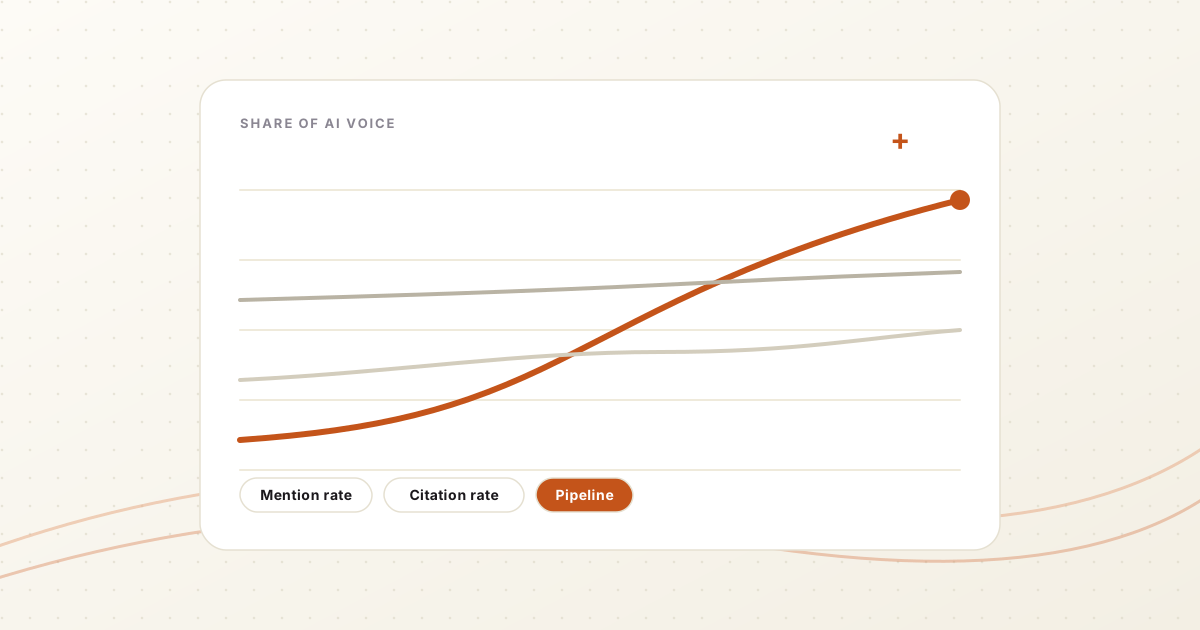
The platform's native reporting covers impressions, clicks, spend, CTR, CPC, and CPM. That data is necessary but not sufficient for B2B SaaS decisions. A demo form submission tells you very little about whether the campaign is generating commercial value. The measurement architecture needs to extend from the ad impression to closed revenue.
The full measurement stack
Build the reporting layer in five stages, each serving a different decision:
| Stage | Example event | Used for optimisation | Used in reporting |
|---|---|---|---|
| Delivery | Impressions, clicks, CTR, CPC | Pacing and creative testing | Diagnostic |
| Engagement | Pricing page views, integration views | Secondary signal | Diagnostic |
| Intent | Demo form submitted | Primary signal when volume is low | Front-end demand |
| Qualification | Qualified meeting held | Stronger commercial signal | Quality |
| Pipeline | Opportunity created in CRM | High-value bidding signal | Pipeline value |
| Revenue | Closed-won | Highest-value outcome | CAC and payback period |
The measurement infrastructure that makes this work requires three components: UTM parameters on every ad placement, the ChatGPT Ads Conversions API wired to your CRM to capture post-click events, and server-side event tracking to fill platform-level reporting gaps.
The conversion lag problem
B2B SaaS sales cycles are long. A buyer who clicks a ChatGPT Ad today may not become a qualified opportunity for six to twelve weeks. This creates a structural problem: if you evaluate campaign performance at four weeks, you are looking at incomplete data. Campaigns that appear to underperform in early reporting often look materially different when pipeline data catches up.
The practical implication: set evaluation windows that reflect your actual sales cycle. Do not change campaign structure or pause spend based on front-end metrics alone. Establish a clear go or no-go review date with a defined hypothesis before the campaign launches.
Paid ChatGPT Visibility and Organic Citation Building: Two Separate Systems
One of the most important things to understand about ChatGPT advertising is what it does not do. Paid placements appear below the organic response. They are clearly labelled as sponsored. They have no influence on what ChatGPT recommends, cites, or includes in its answers.
Two systems, two disciplines
Sponsored placements
- Appear below the organic response
- Clearly labelled as sponsored
- No influence on what ChatGPT recommends or cites
Citation building
- Topical authority through well-structured content
- Clear description of your brand, product and use cases
- Citations from sources AI treats as reliable
This matters strategically because many B2B SaaS teams conflate two distinct commercial objectives: appearing in ChatGPT's organic answers when buyers ask about their category, and reaching buyers through paid placements in the same environment. These objectives require different disciplines and should be managed separately.
What organic AI citation building involves
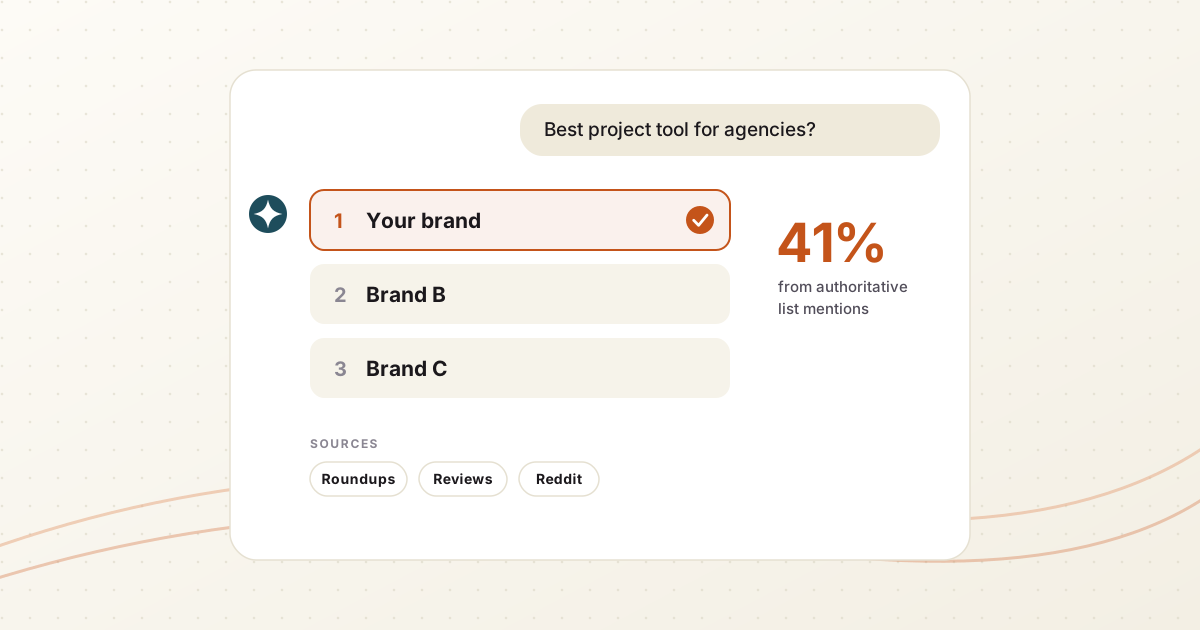
When a buyer asks ChatGPT "what are the best project management tools for a 50-person SaaS company?", the answer is constructed from ChatGPT's training data, indexed web content, and the sources it has learned to associate with authority on that topic. Earning inclusion in those answers is a function of the quality, depth, and credibility of your published content and the authority signals that point to it.
Organic AI visibility work covers:
-
Building topical authority through substantive, well-structured content that AI systems can accurately parse and retrieve
-
Ensuring your brand, product, and use cases are clearly described in a way that allows AI systems to understand what you do and who you serve
-
Earning citations from authoritative sources that AI systems treat as reliable
-
Technical foundations: structured data, crawlability, and entity clarity
How the two systems work together
Paid and organic AI visibility are complementary, not interchangeable. A buyer might encounter your brand through an organic ChatGPT recommendation during early research, then see a sponsored placement during a later comparison conversation. Each touchpoint serves a different moment in the journey.
The strategic position: organic citation building earns you consideration when buyers are not yet in commercial conversations. Paid ChatGPT placement reaches buyers who are already evaluating. Both matter, but neither substitutes for the other.
Teams that treat ChatGPT Ads as a shortcut to organic AI visibility will be disappointed. Teams that build both systems deliberately, with clear objectives for each, are the ones that will compound the channel's commercial value over time.
Where to Start
The teams that get the most from ChatGPT Ads in 2026 are not the ones who moved fastest. They are the ones who moved with a clear hypothesis, a properly instrumented measurement layer, and a campaign structure built around how their buyers actually research.
Before launching, answer three questions:
-
Where in the buying journey does ChatGPT already influence your category? Identify the research conversations your buyers are having: comparison prompts, implementation questions, pricing discussions. These are your first ad group themes.
-
What does a qualified outcome look like, and how will you track it back to the campaign? Define the CRM events that represent commercial progress, not just form fills. Wire the Conversions API before you spend a pound.
-
What landing page experience matches the evaluation stage you are targeting? If you do not have pages that continue the research conversation rather than interrupting it with a generic demo request, build them before the campaign launches.
The channel is live, the auction is still forming, and B2B SaaS is one of the clearest fits in the platform's current advertiser base. The window to learn before pricing matures is open now.
Ready to build your ChatGPT Ads strategy? Book a strategy consultation with Surgelify to map your buyer's AI research journey, structure your first campaigns, and build the measurement architecture that connects spend to pipeline.